


Thaddeus Cahill’s Telharmonium (1906) wasn’t a commercial success, but the principles it embodied were used in later rotating-wheel electromagnetic instruments. The design based on Cahill’s often consists of a number of iron disks with indented edges which are mounted on a shaft and arranged to rotate in front of an electromagnetic pickup. The pitch depends on the number of indentations and the speed of the rotation. The waveshape (timbre) produced approximates the pattern of the indentations. Many builders have used this design or variants of it; of particular interest are the instruments built by Ivan Eremeeff and R.H. Ranger.


Eremeeff constructed several electromagnetic instruments during the early Thirties, using several techniques discussed in a magazine article which appeared in 1932:
The larger instrument is a synthetic type, operating on principles involving the synthesis of fundamental frequencies with harmonic, sub-harmonic, multiple, and fractional frequencies, for the production of musical tones of predetermined pitch, volume, and tone quality.
This is a description of additive synthesis, the creation of complex tones through the mixing of simple tones (sine waves). Instead of this, the following passage describes an instrument utilizing subtractive synthesis, the modification of a complex tone using external circuitry, e.g. a filter.


The smaller instrument, called a Gnome, works on the same basic principles employed in the larger instrument. The Gnome produces tone quality with the aid of a dial wave-alteration control, in which waveforms are modified by the selective connection of the output circuit to different taps of a transformer, or by a system of condensers which are adjusted by dial.
The Gnome had touch-sensitive immovable “keys” made of metal. The performer sat on a metal plate which made their body act as part of the circuitry! Expression devices included a volume pedal, a tremolo pedal, and a sustain pedal which controlled the final release of the tone. Particularly with Eremeeff’s instruments, we are again struck by the early designers’ interest in providing nuance with expression devices under the direct control of the performer.


Another early electromagnetic instrument was the Rangertone Organ (1931) developed by Richard H. Ranger. This instrument had some 50,000 separate circuits, and according to the inventor, a home model would have cost $5,000 (in 1931 dollars!). An unusual feature of the instrument was the amplifier-selection tone color system. The Rangertone had separate amplifiers that acted as individual channels when chords were played on the keyboard. The keyboard was split, and the highest three notes played by the right hand were routed to separate amplifiers; the lower keyboard had a similar arrangement. Thus it was possible to produce six notes with different tone colors by filtering the output of each amplifier independently. Separate tremolos were also possible.

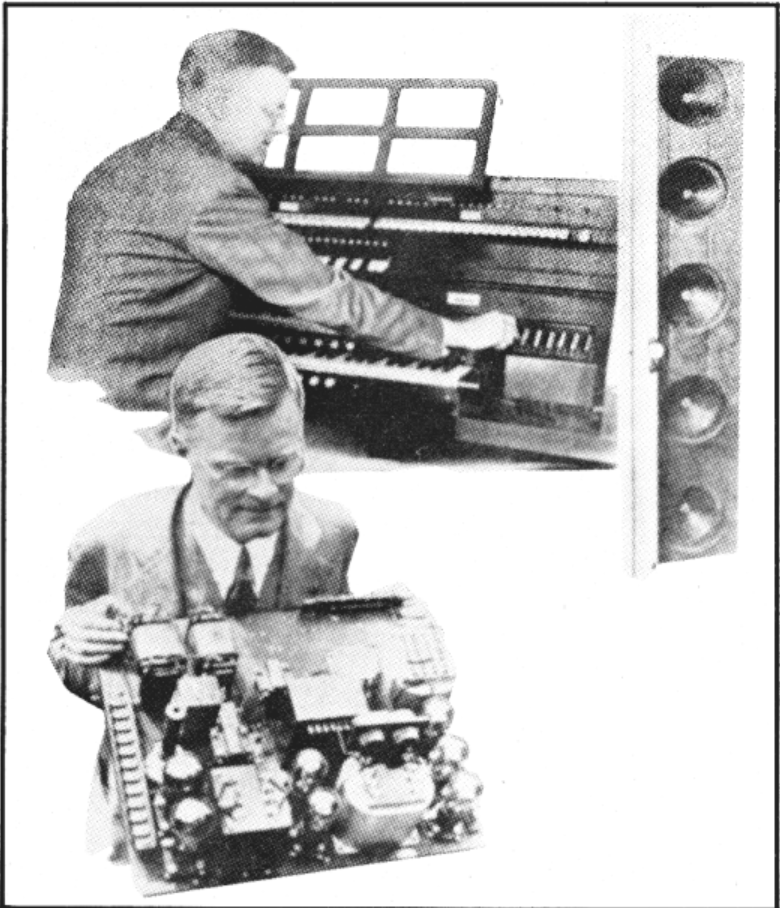
Public demonstrations and a radio debut of the Rangertone produced euphoric reviews. An example:
No longer is the composer limited to the tones of traditional instruments. He can now specify timbres. What will become of the orchestra? Perhaps a quintet seated at keyboards and controlling electrical devices will take the place of an entire symphonic organization. Perhaps a new type of virtuoso will arise, a Paderewski and a Toscanini fused into one super-performer who deals with a thousand horsepower instead of a hundred musicians.
The prediction of the demise of the orchestra was premature. Doubtless, Richard Ranger had no such intentions or delusions. Nor did the reviewer think to ask as simple a question as, “What happens to the individual tone colors of the Rangertone when the lines of the music cross?” Musical imperatives must dictate the design of electronic musical instruments, just as they have the design of acoustic instruments.
Historically, there has been a perennial fascination with the “keyboard-as-orchestra” concept. Given one brain and one pair of hands, a single performer just can’t act like a hundred people. Perhaps it would be more constructive to explore electronic musical instruments for their value as limited but unique instruments.
Next month, the electromagnetic tone wheel makes good: the Hammond Organ story.
ARPIL 1977
View or download the original article here:
