
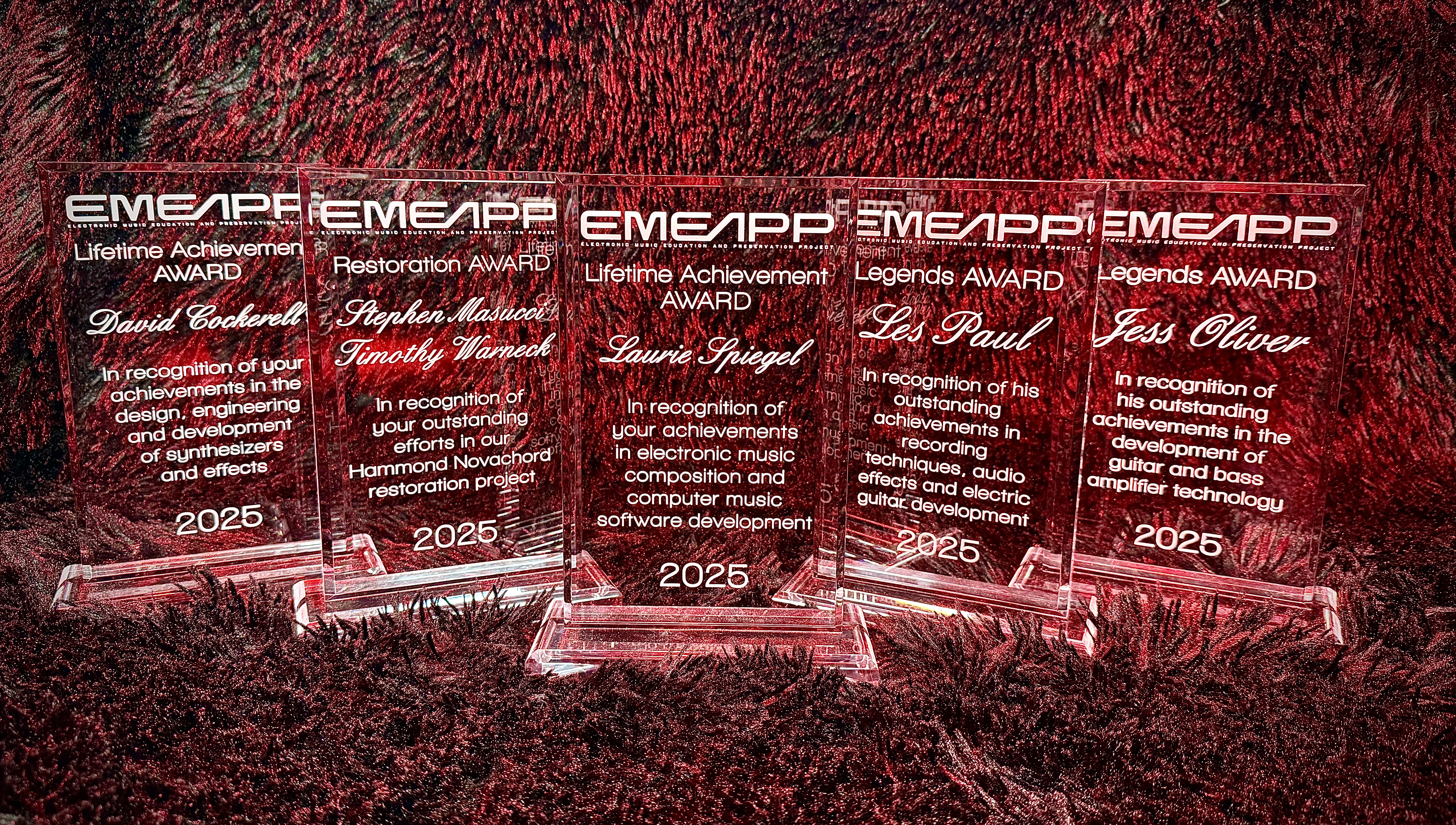
Since 2018, the EMEAPP Recognition Awards have honored individuals who have made a meaningful and lasting impact within the EMEAPP community. What began as a small circle recognizing those involved even before EMEAPP officially took shape, set a high standard during our earliest, formative months.
As EMEAPP has grown, so too has our reach, bringing us face-to-face with an increasingly remarkable and diverse group of innovators. Today, the awards celebrate a broader spectrum of contributors whose work continues to shape, strengthen, and inspire the EMEAPP orbit.
2025 AWARD RECIPIENTS

DAVID COCKERELL
David Cockerell is a pivotal electronics engineer whose technical ingenuity defined the sound of Electronic Music Studios (EMS). Cockerell was the primary architect behind the circuitry of the legendary VCS3 synthesizer and its portable counterpart, the Synthi A. His designs were noted for their 16×16 pin matrix that replaced bulky patch cables, allowing for a compact and highly flexible signal path. He designed the massive Synthi 100, which featured a digital sequencer and 12 oscillators, and the Synthi Hi-Fli, a sophisticated early guitar synthesizer. His career later took him to Electro-Harmonix, where he engineered classic pedals like the Small Stone phaser and the Electric Mistress flanger, and to Akai, where he was instrumental in developing the S-series samplers and the electronic circuitry for the MPC60. Throughout his work, Cockerell demonstrated a masterly ability to implement complex digital algorithms and analog processing on limited hardware, solidifying his reputation as a “tech hero” in the evolution of electronic music.
JESS OLIVER
Jess Oliver was a visionary engineer and musician whose technical innovations during the 1950s and 1960s transformed the landscape of bass amplification. Joining Ampeg in 1956, he quickly rose to the position of Vice President and became the primary architect of the company’s most iconic products. His crowning achievement was the 1960 invention of the Ampeg B-15 Portaflex, which featured a unique “flip-top” design where the amplifier head could be inverted and stored inside the speaker cabinet for transport. Beyond its portability, Oliver’s design included a sophisticated double-baffle porting system and a closed-back reflex cabinet that provided the “fat” and fundamental tone that made it the most-recorded bass amplifier in history.
Oliver pioneered the integration of spring reverb into a guitar combo with the Ampeg Reverberocket, predating similar efforts by other major manufacturers. He was also the primary inventor of the Ampeg Baby Bass, the first successful electronic upright bass, which utilized a fiberglass body and a specialized diaphragm pickup to simulate the sound of a traditional double bass in a compact form.
LES PAUL
Les Paul’s technical brilliance fundamentally altered the DNA of popular music. His most visible success was the development of the solid-body electric guitar, notably his 1941 prototype “The Log.” By mounting strings and pickups onto a solid 4×4 block of pine, Paul solved the feedback and sustain issues that plagued hollow-body instruments, creating a cleaner, more powerful sound. This innovation eventually led to the 1952 release of the Gibson Les Paul, an instrument that became the gold standard for rock, blues, and jazz musicians. However, his work behind the mixing desk was arguably even more revolutionary; he pioneered multitrack recording, sound-on-sound overdubbing, and delay effects. By modifying an Ampex tape recorder to include an extra recording head, he moved music away from “one-take” live performances toward a world where a single artist could layer dozens of parts into a complex sonic tapestry.
For young adults today, Les Paul’s technical successes are the foundation of nearly every piece of music they consume or create. The “bedroom producer” culture, where artists create chart-topping hits using only a laptop and a MIDI controller, is a direct descendant of Paul’s experiments. The very concept of studio-as-an-instrument, where effects like echo and phasing are used creatively rather than just to fix a recording, began with Paul.
LAURIE SPIEGEL
Laurie Spiegel is a pioneering American composer and software designer whose technical successes at the intersection of computer science and art have left an indelible mark on electronic music. During the 1970s, she was a key researcher at Bell Laboratories, where she worked alongside Max Mathews to push the boundaries of early digital synthesis. Spiegel was a primary user of the GROOVE system, which allowed her to interact with computer-generated sounds in real time, a precursor to modern digital audio workstations.
Spiegel’s most influential technical contribution to the wider musical community was the 1986 release of Music Mouse—An Intelligent Instrument. Developed for Macintosh, Amiga, and Atari computers, this software transformed the computer mouse into a performance controller, allowing users to navigate complex harmonic and melodic grids without the need for traditional keyboard proficiency. By embedding musical logic and constraints into the software itself, Spiegel pioneered the concept of “intelligent instruments,” a philosophy that continues to drive the development of modern generative music tools and accessible software. Her technical vision even extended beyond Earth, as her electronic realization of Johannes Kepler’s “Harmony of the World” was included on the Voyager Golden Record, representing human musical innovation to the cosmos.
STEPHEN MASUCCI & TIM WARNECK
Stephen Masucci and Tim Warnek’s restoration of EMEAPP’s 1939 Hammond Novachord at EMEAPP is widely regarded as one of the more challenging and technically demanding feats in the history of instrument conservation. The Novachord is a 500-pound precursor to the modern synthesizer, containing 163 vacuum tubes and over 1,000 capacitors. Over several years, Masucci and Warnek focused on a painstakingly researched forensic reconstruction of this innovative electronic musical instrument.
The rarity of Masucci and Warnek’s technical abilities cannot be overstated, as they possess a “lost” knowledge base that bridges pre-WWII analog engineering with modern conservation standards. Their success at EMEAPP has preserved one of the few fully functional Novachords in existence, saving a haunting, orchestral sound that famously defined the eerie scores of The Twilight Zone and Hitchcock’s Rebecca. In an era dominated by digital software, technicians who can navigate the volatile chemistry and intricate point-to-point wiring of 1930s “thermionic” synthesis are a disappearing breed.
2024 AWARD RECIPIENTS

ADRIAN BELEW
Adrian Belew is a renowned guitarist, vocalist, and composer famous for his innovative and experimental style. Although he is most well-known as the guitarist and frontman for King Crimson, he has also collaborated with artists as varied as Frank Zappa, David Bowie, Talking Heads, and Nine Inch Nails. On his most recent tour, BEAT, he teamed up with Tony Levin, Steve Vai, and Tool drummer Danny Carey to perform 1980s King Crimson songs.
We at EMEAPP especially appreciate his innovative use of guitar synthesizers and effects pedals to create a whole new palette of never-before-heard sounds. From the earworm-y riff on Tom Tom Club’s Genius of Love to the animal impressions on King Crimson’s Elephant Talk, Belew coaxed an impressive array of sounds out of his guitar using various playing techniques, effects pedals, and synthesizers. His dedication to pushing boundaries through his experimental techniques has created a lasting legacy and inspired a whole new generation of guitarists.
SUZANNE CIANI
Suzanne Ciani, aka “Diva of the Diode”, was one of the first female electronic music composers and performers. While obtaining her master’s degree in music composition at Berkeley, she took a summer course in computer music from fellow EMEAPP Award winners Max Mathews and John Chowning. After meeting Don Buchla and immediately seeing the potential of his synthesizer, she went to work at Buchla and Associates to earn money to purchase a Buchla system of her own.
She has had an incredibly long and successful career as a composer, sound designer, and performer using her Buchla synth. She worked on several advertisements for Coca-Cola and other major companies and actually created the iconic sound of the Coke bottle being opened and poured using her synthesizer. She composed several movie and TV soundtracks and provided sounds for the pinball game Xenon (including her own voice run through a vocoder – the first female voice ever to be featured in a pinball game), which later resulted in her induction into the Pinball Hall Expo of Fame. She has also released several albums of her own music and she is still performing and producing to this day.
As one of the first successful female electronic music composers, Ciani spent her lifetime breaking down barriers. While at Buchla, she signed up for an employees-only synthesizer class only to be told “we decided we don’t want any women in the class.” She agreed to appear on the David Letterman show in 1980 only to find the producers cut to commercial break as soon as she started performing. Her perseverance through these and many other obstacles truly paved the way for women to succeed in the electronic music world.
HERBIE HANCOCK
Herbie Hancock is a true genre shapeshifter, spanning everything from acoustic jazz to funk to pop to electronica. While he began his career as a jazz musician with Miles Davis, he soon added rock and pop elements. With his own band, Hancock released a series of albums that fused jazz improvisation with elements of contemporary classical electronic music. Hancock and his bandmates were early adopters of the Fender Rhodes, ARP Odyssey, ARP 2600, ARP Pro Soloist, Mellotron, and Moog synthesizers. He released an album of traditional acoustic piano music then followed it up with albums of jazz-fused disco. He was an early user of the vocoder on his hits I Thought It Was You and You Bet Your Love.
In 1983, his biggest hit, Rockit, was the first mainstream single to feature scratching, and its attention-grabbing animated music video swept several categories at the MTV Video Music Awards. Hancock would release several other electronic music albums through the 1980s before returning to his jazz roots again in the 90s. He even released a George and Ira Gershwin tribute album. The artists Hancock has collaborated with over his career are far too numerous to list and include such diverse talent as Stevie Wonder, Chick Corea, Carlos Santana, Joni Mitchell, Leonard Cohen, Christina Aguilera, Sting, Josh Groban, Duran Duran, and Lang Lang. He is still performing and recording to this day, and, as a professor at UCLA, he continues to share his talent and knowledge with future generations of musicians.
MAX MATHEWS
Max Mathews is the father of computer music. A Caltech- and MIT-trained electrical engineer, Mathews worked at Bell Labs in the 1950s, where he became fascinated with the idea of using their computers to make music. In 1957, he created MUSIC I, the first widely-used computer program designed for sound generation. He later gave the program to John Chowning, who brought it to Stanford and ultimately used it to develop FM Synthesis.
Mathews spent the rest of his life experimenting with computer-generated sounds and music. His early work was created for large cumbersome mainframes and required a lot of time for compiling and processing before sounds could be generated, making them suitable only for studio production. In 1970 he created GROOVE (Generated Real-time Output Operations on Voltage-controlled Equipment), the first program to make computer-generated musical capability available in a live performance setting. All of today’s DAWs, VSTs, and live performance programs like Apple’s Mainstage would not exist without Mathew’s pioneering research.
2023 AWARD RECIPIENTS

DR. JOHN M. CHOWNING
Dr. John Chowning brought the concept of digital Frequency Modulation (FM) synthesis to the world of music production and performance. Synthesizers like the Yamaha DX7, with its signature metallic twangs and ethereal bell-like tones, wouldn’t exist without his groundbreaking work.
But Dr. Chowning’s brilliance goes beyond a single invention. He co-founded CCRMA, a global hub for computer music innovation at Stanford University. His influence ripples across fields like sound design, film scoring, and even medical research. He’s a beacon for aspiring artists and engineers, sharing his knowledge and passion through workshops, lectures, and online resources.
GREG LAKE
Greg Lake, multi-instrumentalist and the voice behind of Emerson, Lake & Palmer and early King Crimson, was a beloved figure in the world of progressive rock. His impact resonates far beyond catchy melodies and virtuosic instrumental prowess; he was a visionary who redefined the boundaries of rock music and captivated audiences with his strong stage presence and boundless creativity.
Lake’s work showcased his ability to blend classical influences with rock sensibilities, resulting in music that was both intellectually stimulating and emotionally resonant. His collaborations with Keith Emerson and Carl Palmer weren’t mere showcases of individual brilliance; they were a true fusion of talents, where each member elevated the other, culminating in a sound that was uniquely their own.
TOM OBERHEIM
Tom Oberheim, the sonic architect behind iconic synthesizers like the SEM and the OBX series, is a titan in the electronic music landscape. His impact on the world of sound is undeniable, woven into the very fabric of countless musical genres.
Oberheim’s instruments weren’t just innovative; they were revolutionary. The SEM, released in 1974, was one of the first commercially successful monophonic synthesizers, boasting a fat, powerful sound that graced countless hit records. Its raw, versatile tone was embraced by artists like Pink Floyd, Stevie Wonder, and Kraftwerk, shaping the soundscapes of the 70s and beyond. His designs have been intuitive, playable, and invited experimentation, fostering a deep connection between musician and machine.
DAVE SMITH
Dave Smith, the mastermind behind Sequential Circuits, stands as a towering figure in electronic music. His legacy echoes through countless musical genres, leaving an undeniable mark on the way we create and experience sound.
His instruments themselves are legendary. The Prophet-5, the world’s first fully programmable polyphonic synth, opened a Pandora’s box of sonic possibilities, influencing generations of musicians and shaping the 80s soundscapes. Sequential Circuits went on to produce iconic synths like the Prophet VS and Pro-One, each a testament to Smith’s innovative spirit. But his reach goes beyond individual instruments. Smith was instrumental in crafting MIDI, the universal language of electronic music, allowing instruments to sing in perfect harmony, regardless of their maker. This revolutionary standard forever changed the way musicians collaborate and create.
2022 AWARD RECIPIENTS

TONY BANKS
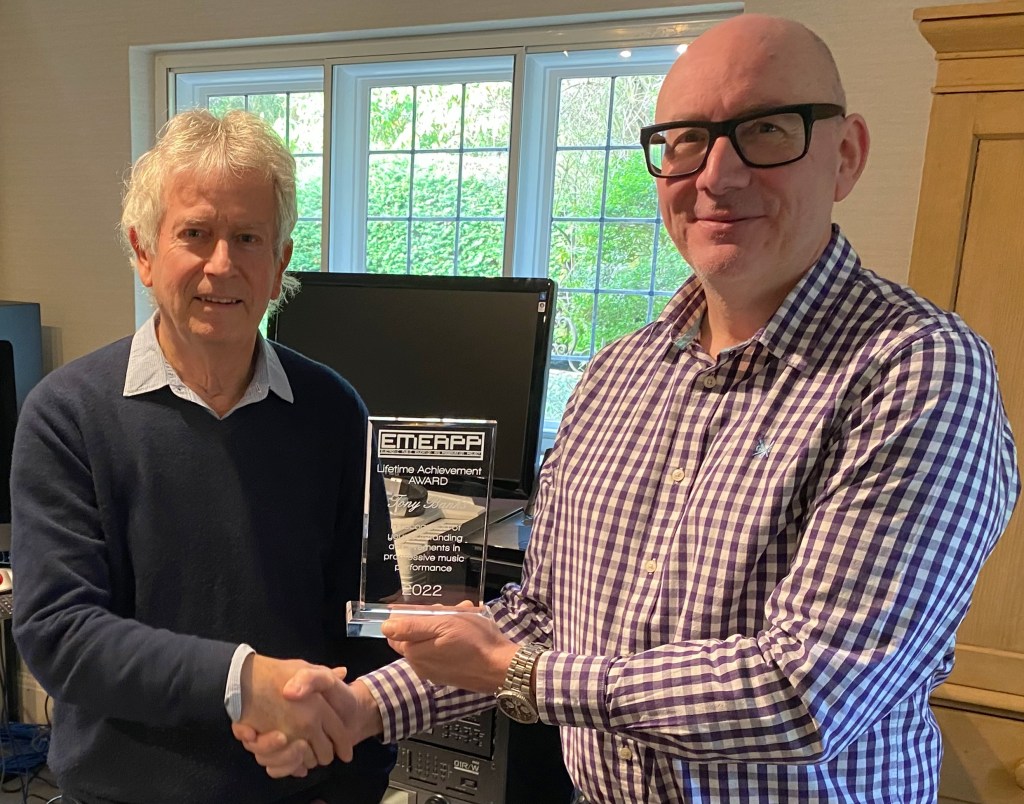

As the keyboardist and primary composer/arranger of the band Genesis, we hold Tony in the highest regard. His highly distinctive keyboard sounds and stylings have been integral to the band’s sound and dynamic, and his compositions for the band have become classic and timeless. Add to this his orchestral work, his solo efforts and film scoring work and you have one of the most well-rounded musicians out there. His abilities in sound design are equally impressive and his playing skills are unparalleled. He has also released several solo albums, created multiple film soundtracks and collaborated with other artists including Mike Rutherford and Peter Gabriel.
EMEAPP Associate, Andrew Ward, was on hand to present the award and certificate to Tony. Even better, longtime Genesis manager, Richard Macphail was there, what a perfect scenario!
MICHELLE MOOG-KOUSSA
If ever anyone deserves an award for managing a vital legacy it would be Michelle. As the primary flagbearer of her father’s celebrated synthesizer and theremin innovations, we appreciate Michelle’s efforts in bringing the work of our electronic hero to the world. Her work in creating and cultivating the Bob Moog Foundation was a huge step in solidifying his legacy, the Foundation’s “Moogseum” has become a destination for his admirers who are traveling through Asheville, North Carolina. Michelle also administers “Dr. Bob’s SoundSchool”, a program that teaches students about the science of sound. EMEAPP thanks Michelle for all that she does to promote the history of Bob Moog and electronic music.
AL GOFF
A Hammond tonewheel organ is beautiful, but a Goff-customized Hammond is a working and touring beast! Al Goff is the master at getting the best out of these beautiful electronic instruments and we are proud to tip our hats to him. From Keith Emerson to Gregg Allman, from Jimmy Smith to Joey DiFrancesco, Al Goff has kept some of the most famous Hammond organs alive and ready to light up audiences around the globe.
EMEAPP selected Al Goff for his efforts in preserving Keith Emerson’s Tarkus Hammond C3, Emerson’s Pictures At an Exhibition Hammond C3 and his Hammond L-100 that caught fire in Boston in 1997.
STEPHEN MASUCCI
Very few people are able to deal with the complexities of restoring vintage electronic instruments. But our 1939 Storytone electric piano, Gershon Kingsley’s “Popcorn” Moog and a few of our 1939 Hammond Novachords have new lives because of Masucci’s technical prowess. EMEAPP proudly welcomes Stephen to our esteemed roster of award winners.
2021 AWARD RECIPIENTS

JAN HAMMER
Jan Hammer overtook the world as keyboardist with Mahavishnu Orchestra, Jeff Beck and beyond. But his musical reinvention in the mid-1980s was meteoric with the success of his soundtrack work on the TV series, Miami Vice. Jan is a master of the Minimoog and took the Fender Rhodes electric piano to uncharted lands. His performance style is easily recognizable and has inspired legions of keyboardists and composers. Oh, did we mention that he is also a smoking drummer? Mmmhmm.
RICK WAKEMAN
Rick’s primary role has been the keyboardist for the band YES, but playing keys on David Bowie’s “Life On Mars” is kinda cool too, eh? Wakeman’s ability to manage complex parts is fascinating, his sound design is exceptional. We proudly display a collection of Rick’s gear here at EMEAPP, our hearts race every time we walk into the space with his beloved Hammond organ, Minimoog and more.
MALCOLM CECIL
Malcolm Cecil was the main mind behind the synthesizer TONTO, a one-of-a-kind assemblage of electronic music technology that could create a virtually limitless palate of sounds. This instrument led Cecil to a musical relationship with Stevie Wonder that begat the innovative albums Talking Book and Innervisions. We would like to thank our good friend, Dina Pearlman, for accepting this award on his behalf.
2020 AWARD RECIPIENTS

GEORGE SECOR
George Secor was the master of microtonal scales and the instigator of unique intervals. He is responsible for the discovery of “the miracle temperament” and played a major role in adding the Bosanquet (standardized) keyboard to the famed Motorola Scalatron. In fact, he donated his personal Scalatron to EMEAPP when he passed, for which we are eternally grateful.
ALAN R. PEARLMAN
Alan R. Pearlman was awarded posthumously as a founder and designer of synthesizer maker, ARP, whose innovative instruments opened new doors for performers and sound designers. His electronic designs created a new palate of sounds and musical opportunities. From the ARP 2500 to the 2600, from the Pro Soloist to the beloved Odyssey, from the Avatar to the Quadra Pearlman really made a difference.
PATRICK MORAZ
Patrick Moraz is a career electronic musician and performer who has clocked many miles as a solo artist and member of the bands Yes and the Moody Blues. His improvisational work with drummer Bill Bruford was innovative and exciting, his solo piano work is liquid and fantastic. Patrick is always fun to be around and we look forward to his next visits to EMEAPP.
WENDY CARLOS
Wendy Carlos is a musical trailblazer who broke the synthesizer sound barrier in 1968 with her release of “Switched-On Bach”. This innovative album helped propel the synthesizer to fame as a legitimate instrument and not a novelty. She has made significant contributions to the field of electronic music, including early experiments in synthesizer technology and sonic manipulation. Her work has served as an inspiration to many.
2019 AWARD RECIPIENTS

KEITH EMERSON
Keith Emerson was the basis of our 2019 awards. He won our Legends Award because he was a legend, to his fans, leagues of keyboardists, fans of rock, fans of classical. His iconic and legendary Moog modular synthesizer sits here at EMEAPP as a torch that still burns, a reminder of the breadth of works that he left us to enjoy for generations.
GENE STOPP
Gene Stopp was vital in the rebuilding of Keith Emerson’s Moog modular synthesizer, his knowledge of its inner workings and history runs deep. Gene is also responsible for the design and creation of many other pieces as well, including the reissue of the Moog Vocoder, modulars, and of course the reissues of Keith’s big synth.
BRIAN KEHEW
Brian Kehew seems to be everywhere. Sometimes a music historian, other times a recording engineer, but always deep into a unique and unbelievable project. He plays a tech role with the band The Who and has been a touring technician for countless bands. In 2006 Brian published the tome Recording The Beatles: The Studio Equipment and Techniques Used to Create Their Classic Albums. He is 50% of the band Moog Cookbook with Roger Manning Brian. Kehew won two EMEAPP Awards in 2019, a Preservation Award and a Restoration Award for his efforts in rebuilding Keith Emerson’s famous Moog modular synthesizer.
2018 AWARD RECIPIENTS

BOB MOOG
Dr. Robert Moog is one of the main reasons that EMEAPP exists. His innovative work fills our hallowed halls, his fantastic machines make sounds that have been heard around the world for decades. His creative thinking and innovative ideas truly changed the trajectory of electronic music.
DAVID VAN KOEVERING
David Van Koevering was a multi-faceted individual who helped create the market for synthesizers. He brought these new-fangled machines to schools, universities, recording studios and rock stars. His unique perspective led to dozens of innovations throughout his storied career. His efforts to boost sales of the Minimoog was truly innovative as it was literally the first of its kind! He also created the Orchestron, an optical disc-based keyboard based on Mattel’s Optigan.
JIM SCOTT
Electrical engineer, Jim Scott, came to us because of our interest and obsession with the Moog Minimoog. Jim was the Lead Designer on that project which certainly makes him a great source of intel! Jim is a true EMEAPPer, having spent literally months in our building before and during the onslaught of COVID. Jim is up there in years and is very sensitive from a health viewpoint, so special care had to be taken to maintain his safety and health during his stay. But during his stay, he was freakishly productive and always a blast to spend time with!
TOM RHEA
From writing the operator’s manual for the famous Minimoog to being a professor of music synthesis at Berklee, Tom is deeply involved. He was in the trenches at MOOG back in the day and has been quite a resource of intel for us. He was also deeply involved in the creation of the beloved Crumar Spirit monophonic synthesizer. We appreciate that Tom is only a phone call away and is always willing to help out.
RAY KLOS
Ray was pivotal in the refurbishment of dozens of instruments in our earliest combo organ collection. This process required a broad knowledge of electromechanical and electronic dealings, Ray Klos was a perfect fit at the perfect time. His wide berth of electronics knowledge and know-how helped bring these beautiful instruments into compliance so that a whole new generation can hear them.