

Marshall McLuhan, media sage, says that the content of a new medium is likely to be an older medium. Some of the early movies contained vaudeville, and the content of television is often the older medium of film. When the videotape system becomes commonplace, its primary content will probably be television. Perhaps the content of a new musical instrument—its repertoire—is also derived from previous instruments. For instance, the content of Wendy Carlos’ Switched-On Bach is heard via the new medium of the multitrack tape recorder. Don’t we actually hear an older medium—the orchestra?
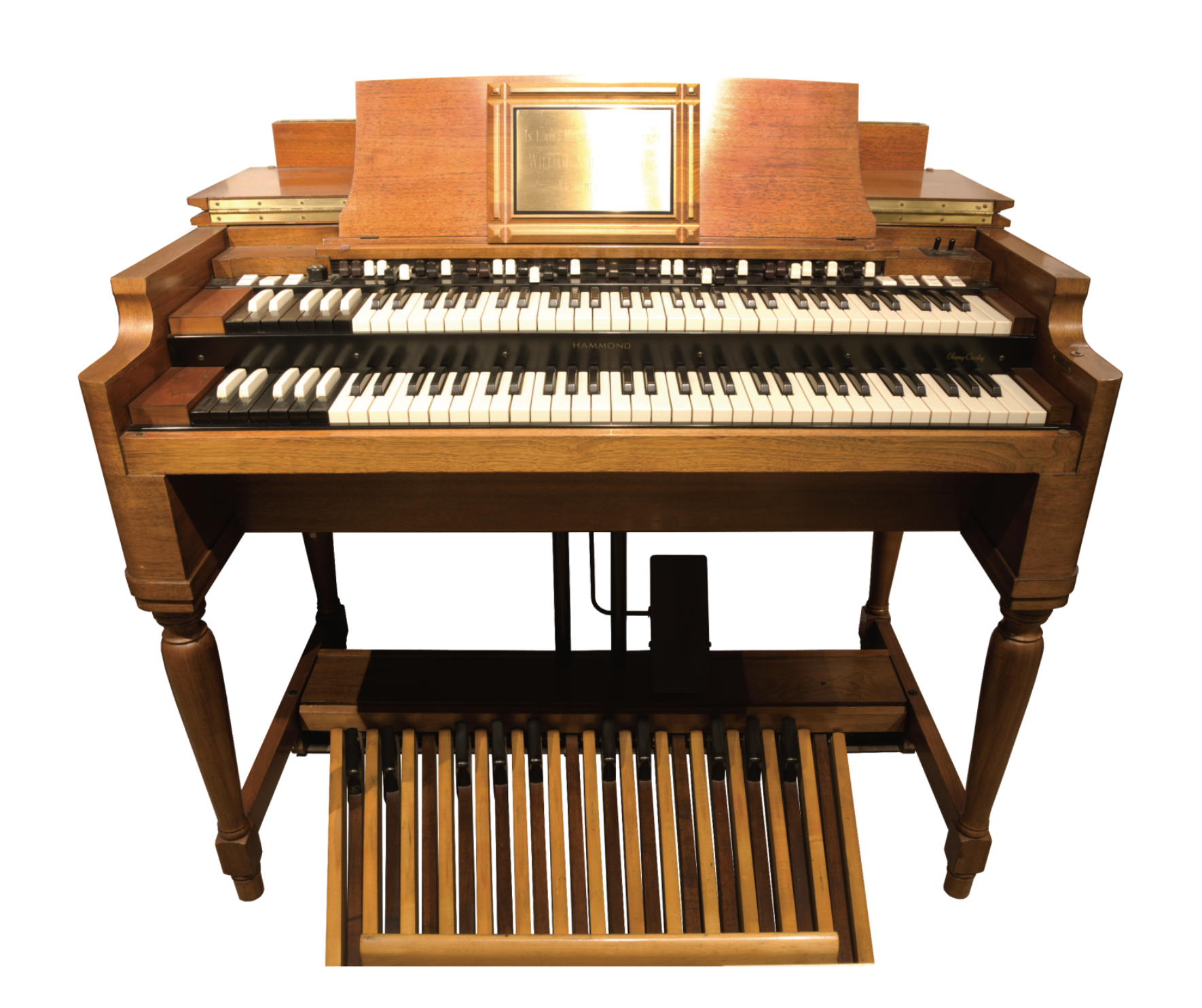
Even those instruments destined for success go through a trial by comparison with earlier instruments, often suffering from derogatory comment. This fact escapes us because we don’t make the connection between the story from the past and the spectacle of the present. Not many people are aware, for example, that as recently as the Sixties, the American Federation of Musicians tried to ban the synthesizer. Or that the introduction of the RCA Synthesizer in 1955 created a heated controversy between the A.F.M. and RCA. In the same way, the Hammond Organ Company was called before the Federal Trade Commission in 1936 for having the audacity to call their instrument an organ!

Hammond versus the FTC is a classic episode in the history of electricity and music; a story that continues to have implications today. When Laurens Hammond introduced his organ in 1935, he said that it shouldn’t be compared with any other instrument; that it had a “voice of its own.” But in 1938, the FTC ordered the Hammond Company to cease and desist from representing that its Hammond Organ “produces the entire tone coloring necessary for the rendition, without sacrifice, of the great works of classical organ literature”; that “it covers the entire range of musical tone colors”; that “any tone that is a sustained tone can be produced on this marvelous instrument”; and that “an infinite variety of tones, covering the flute, diapason, string, and reed families, are instantly available to the organist.”
No one, including the Hammond Company, would make these claims today in behalf of the instrument. In fact, the Hammond Company had already dropped these advertising phrases by the time the FTC ruled. The ruling was actually a victory for Hammond, since it vindicated their use of the word organ to describe the instrument.
Today, an organ is an organ is an organ. But in 1936, pipe organ manufacturers insisted that the new Hammond gadget could never be called an organ; they suggested it might be called an “electro-tone” to avoid confusing the public. During the court battles that ensued, there was a great deal of talk about the “faulty” harmonics of the Hammond, which were based on the equal-tempered scale. There were arguments concerning the construction of the human ear, and tests using tone analyzers that yielded complicated oscillographs. To shift to current perspective, you can imagine Jimmy Smith saying: “Hmmm. Neither a Rohr Flute nor a Koppel Flute. Must be a useless registration!”
The furor reached its zenith when a Hammond organ was pitted against the $75,000 Skinner pipe organ in the chapel of the University of Chicago. Nine experts and fifteen University of Chicago students, the latter picked at random, were marched in for the test. Thirty selections were played, some on the Hammond and some on the Skinner; the panel was asked to tell which instrument was being played. The experts averaged about ten mistakes apiece, while the students came out about 50-50. The importance of the event lies in its occurrence, not in the interpretation of the results. However, the laws of probability do indicate that the students’ judgments could have been duplicated by tossing a coin!
Beneath the smokescreen of talk about the debauchery of the word organ, there was some hard economic reality. The peak year for the pipe organ industry in this era had been 1927. By 1935, when the Hammond was introduced, there had already been a decline of some eighty percent in pipe organ sales. The electrical intruder was economical, portable, and reliable. Pipe organ makers were feeling the pinch. Some five thousand Hammonds were sold in the first three years, and about 35% of these went into churches. I believe, though, that the Hammond Company would soon have suffered if their organ had been perceived solely as a substitute for the pipe organ. As is often the case, the new instrument created a new market, and found its own position without displacing its predecessor.

There are certain parallels between this story and the present climate for the sale of synthesizers. How much nonsense have we heard about the “infinite” potential of the voltage-controlled synthesizer, which will supposedly make the sounds of “every instrument in the orchestra.” (I’ve never heard an actual designer of a synthesizer make this claim.) How many arguments must we endure about esoteric notions such as the “purity” of the waveshape produced by an oscillator? (Musical instruments—and musicians!—have never been very pure. Virgin sinewaves we don’t particularly need.) And now we must contend with the apparently magical word “polyphonic,” which can transform an organ into something it isn’t. Even the word synthesizer is of little use, since this can now mean anything from a legitimate musical instrument to a wah-wah pedal that promises the musical moon.
Claims as extravagant as the medieval argument about how many angels could dance on the head of a pin seem often to accompany new developments. A study of the history of electrical musical instruments suggests, however, that these survive despite rather than because of the hype that is written about them. This will undoubtedly be the case with the synthesizer.
Next time, we’ll start the first of several columns on photoelectric musical instruments.
JUNE 1977
View or download the original article here: