
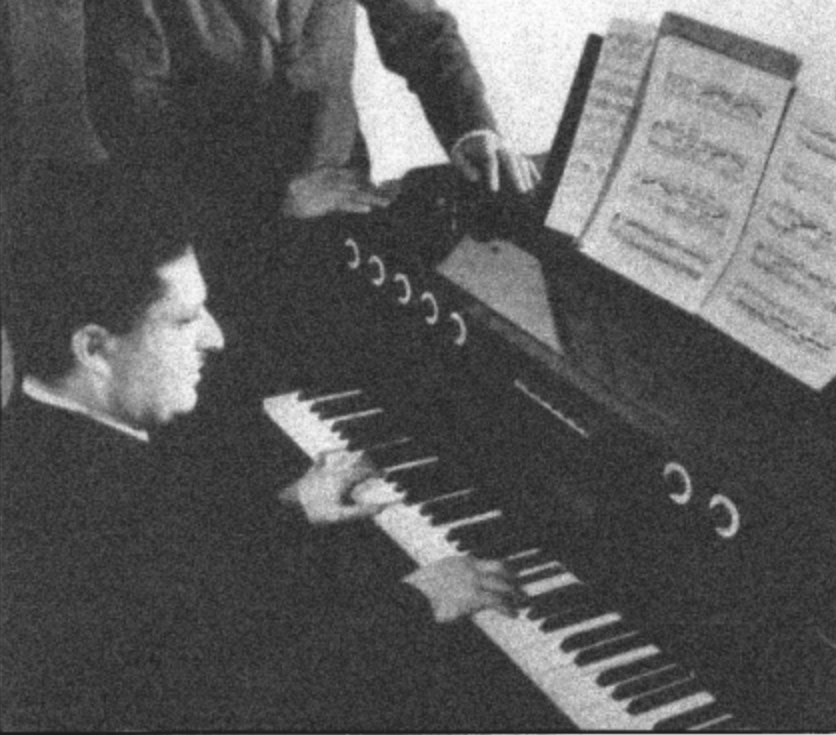

Benjamin Franklin Miessner (born 1890) is a central figure in the development of the electric piano. His early career was in radio and electro-acoustics. In 1909 he developed an improved “cat whisker” detector used in crystal radio sets. In the ’20s he pioneered the totally electric phonograph for the Brunswick Phonograph Company. Later he produced for the Garod Radio Company some of the first radios powered by alternating current. Many of the important names in the industry, including Stromberg-Carlson, Federal, Zenith, General Motors, Crosley, and Howard, were licensees for his radio patents.
In 1930 Miessner set up his laboratory in Milburn, New Jersey, and began to electrify every conceivable instrument—even kettledrums and the harmonica! His interest in the electric piano was stimulated by his brother, Otto Miessner, a noted music educator. Otto Miessner dreamed of a piano suitable for music teaching that would be portable, inexpensive, and aesthetically pleasing. As Benjamin Miessner laughingly told me, “Otto wanted me to make an electronic piano that you could sell for ten dollars!”
Benjamin Miessner’s work with the electric piano evolved in several phases. Initially he tried just about everything that would vibrate—reeds, tuning forks, rods, and bars. He found that most of these lacked the harmonic structure needed for piano-like tones. Special hammer-struck string arrangements were tried, but required too-frequent tuning. Miessner then turned to conventional pianos with the soundboard cut away, and tried a variety of proximity pickups.
Miessner’s first commercial model—the Electronic Piano—was introduced in the early ’30s. He described it:
My Electronic Pianos use no soundboard, but the strings do bear on a bridge supported by a skeleton structure of ribs. My piano strings are supported in these respects as in a conventional piano, but the sound-radiating efficiency is vastly reduced. My purpose is to subdue the direct mechanically produced tone, and to provide instead electronic apparatus for tonal development of the string vibrations. These electrostatic pickup devices do not respond in the least to air-borne waves. They do, by their proximity to the strings, translate the string vibrations into corresponding electrical vibrations which are amplified and reproduced electrically.
Miessner’s Electronic Piano had a separate pickup for each of the 88 string groups. An electrostatic pickup of this type has a screw or other small conducting object mounted near the string that is to be set into vibration. The screw and string comprise the plates of a small capacitor. A polarizing voltage is applied to each screw through a filter network. When a string vibrates, the capacitance between the string and screw varies. This is translated into a varying voltage that can be amplified and translated into sound.
Miessner explored and used the general characteristics of a vibrating string in order to alter timbre and voicing and to provide envelope control. By placing pickups at specific points along a vibrating string one can select and mix various partials to produce various tone colors. Dynamic voicing involves placing each pickup at an appropriate distance from its string group, thereby altering the strength of the vibrations received. Envelope control is achieved by placing pickups at various angles to a string. When a string is struck, it first vibrates in the direction of the striking force; a short time later it will also begin to vibrate on a plane perpendicular to the original vibration. By picking up and mixing vibrations on several planes, one can control the attack characteristic. This makes it possible to imitate non-percussive instruments. Such imitations are also facilitated by the longer sustain time of the strings when no soundboard is present to dissipate energy.
Miessner pointed out that many instrumental timbres would be made available by proper placement of the pickups. He also supplied treble and bass controls on his Electronic Piano for further tone color alteration (see photo). Miessner was aware of a more subtle way of influencing timbre:
Further variation in tone is provided in the volume control, with which the performer can set the maximum sound power obtainable, but leaving to him still complete dynamic control over individual tones through keyboard touch. Some interesting effects result from its use. For example he may set his amplification weak and play with fortissimo touch on the keyboard. This produces brilliant tones but at low power. Conversely, he can set his amplification strong and play with pianissimo touch, which produces dull tones at high power. [In the case of acoustic instruments] these two characteristics of quality and power simply cannot be dissociated from one another and separately controlled. But with electronic tone production principles there is not the slightest difficulty in doing this. [emphasis added.]
Here Miessner pointed out a fundamental difference between acoustic and electronic instruments. Prior to the age of electricity, all musical instruments had been characterized by integration of sound properties. For instance, the trumpet has a built-in relationship between timbre and loudness: soft sounds tend to be mellow and loud sounds are brilliant. You just can’t tear instruments made of metal and wood apart easily to afford independent control over sound properties. But electronic technology revolutionized this concept. For instance, screaming-loud trumpets can be recorded and reduced to a low level in the final mix. In this case we can override the physical tendency of the instrument and create a brilliant but quiet trumpet sound. Maybe this is what early composers were trying to achieve when they wrote “offstage” trumpet parts!
Of course this movement toward segregation of the control of sound properties naturally leads us to the synthesizer and the computer. Viewed in this light, “computer music” has more implications in the production of sound than as a surrogate for performance technique. That is, perhaps the most fruitful use of computer technology will be to assist the performer rather than to replace him!
Miessner’s early contribution to all of this was received warmly. In February 1932 he and pianist Anton Rovinsky gave a demonstration of the Electronic Piano before the American Institute of Electrical Engineers. The session, entitled “The New Music of Electrical Oscillations,” also featured the Rangertone Organ (see my column for Apr. ’77), and Professor Theremin’s “ether wave” instruments.

In February of the following year, Rovinsky presented a complete recital at the Aeolian Hall in New York. The program included music by Bach, Scarlatti, Chopin, De Falla, Debussy, Ravel, Tedesco, and Rovinsky. Each selection was followed by a comment on the timbre such as “suggesting a mixture of clavichord and oboe tone.” Later appearances included a Carnegie Hall Program with Ferde Grofé and his Orchestra in 1937, and a program of “Music and Electricity” presented before the League of Composers in 1938.
In my next column we’ll explore the legacy of Miessner’s Electronic Piano.
FEBRUARY 1978
View or download the original article here: