
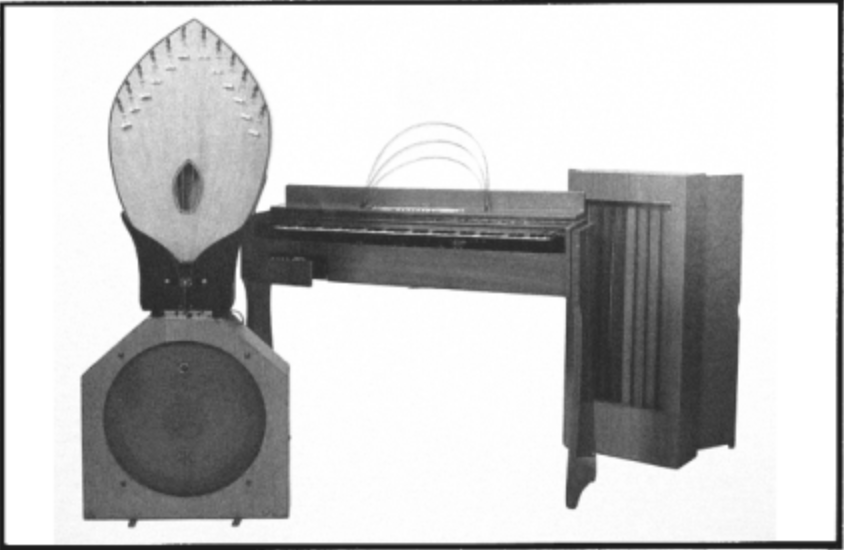

Most musical instruments have a repertoire, a body of compositions referred to as that instrument’s “literature.” For a variety of reasons, many electronic musical instruments have little or no repertoire. For instance, how can you write for the synthesizer? It’s not a fixed musical entity, like the flute, piano, or trumpet. And many electronic instruments have been only pallid imitations of more expressive instruments, offering little interest to the composer. Also, some electronic musical instruments have been so difficult to master (e.g., the Theremin) that there are few virtuosos to justify a large repertoire. Whether it is acoustic or electronic, a musical instrument builds a repertoire when: (1) its design becomes fixed; (2) it is capable of enough musical nuance to attract composers, and (3) performers feel justified in devoting hours of practice to its mastery.
The repertoire champ of electronic musical instruments is Maurice Martenot’s Ondes Musicales—”musical waves.” This instrument is often called the Ondes Martenot, or simply the Martenot. Over five hundred works have been written which use the Martenot. There are both orchestral and chamber works, including ensembles for trios or quartets of instruments. Some composers who have written for the Martenot are Olivier Messiaen, Darius Milhaud, Dimitri Levidis, Arthur Honegger, Florent Schmitt, Jacques Ibert, André Jolivet, Jean Martinon, Maurice Jarre, and Edgard Varèse.
The preponderance of French composers is no accident. The Martenot was developed in France in 1928. It has become particularly popular in French radio, television, and stage music and has found use at the Opéra National, the Opéra Comique, the Comédie Française, the Théâtre National Populaire du Palais de Chaillot, and the Folies Bergère.

The Martenot underwent numerous design changes that enhanced its musicality (and thereby increased its repertoire). The instrument uses the same heterodyning tone generation method as the Theremin (see last month’s column): Two ultra-high oscillators produce an audible difference tone. Maurice Martenot must have realized the difficulty that the “space-controlled” Theremin presented to the performer. From his earliest models, Martenot included ways to give the performer tactile and visual feedback for accurate pitch control. On the first instruments, pitch was controlled continuously using an endless wire or band arranged on pulleys to rotate a variable capacitor within the instrument. A small plastic ring was attached to this band. The performer placed the forefinger of the right hand in this ring to move the band, rotate the capacitor, and ultimately change the pitch. To help in the location of discrete pitches, a painted “dummy” keyboard was placed under the pitch band. By moving the finger to the visual reference points provided by this dummy keyboard, the performer could easily arrive at traditional discrete pitches.

The instrument was keyed by the left hand, which controlled a small button that provided articulation. This Touche governed the envelope, or loudness shape (an interesting situation: articulation and pitch control divided between the hands—more like a wind instrument than a keyboard). The left hand also controlled other stops which gave a choice of eight tone qualities. Timbre was controlled by switching on filter circuits that acted on harmonics produced in the first stage of the amplifier.
Later improvements included the addition of more timbre stops and an acoustic resonator to improve overall tone quality; introduction of a true keyboard, making non-gliding playing possible; and the introduction of a more sophisticated variable pitch scheme in place of the original pulley-controlled version. The newer pitch band can be used in conjunction with the keyboard to create portamento (glide). Once again, performance is aided through a system of indentations on the front of the cabinet below the keyboard; these let the performer feel interval size (by counting indentations). Some models have a five- or seven-octave keyboard that lets the performer control vibrato by shaking the keyboard from side to side. Refinements such as these let the performer do what must be done to create a nuance-filled musical voice: bend pitch and create vibrato selectively.

Maurice Martenot introduced the Ondes Martenot at the Paris Opera in 1928 scarcely a year after Leo Theremin had amazed Parisians with his Etherphone (Theremin). The Ondes Martenot, like the Theremin, was an immediate success. The inventor was asked to give a special performance for the President of the Republic later that year.
After a European tour, Maurice Martenot arrived in the United States to demonstrate his “Instrument of Musical Waves.” The first concert in this country was given in 1930 with the Philadelphia Orchestra under the direction of Leopold Stokowski. The program included several transcribed works and a symphonic poem written for the Martenot by Dimitri Levidis. In December the Martenot was featured in a Carnegie Hall concert. The new “ether wave” instrument was acclaimed by some as musically superior to Professor Theremin’s instrument:
The tones were not always agreeable; but they lacked the distressing portamento that marred the performances of Professor Theremin, and they had far more flexibility of utterance.
Apparently the principle governing both devices [Martenot and Theremin] is the same; but Monsieur Martenot uses a different kind of apparatus, and, what is much more important, gets different and better musical results from it. He has eliminated certain of the earlier crudities and defects that marred this “music from the ether.” He has not only tamed the “howl,” he has taught it politer musical manners.
In fairness, it must be noted that the reviewer might have been making a comment on the performers, not the instruments. The Theremin is extremely difficult to play, and virtuosi did not appear on the scene immediately.

In 1931 the Martenot was played over WABC’s network in its American radio debut—another program of transcriptions. The instrument’s later history in America includes its use for film music, jingles, and commercials. Raymond Scott, composer and inventor, and the late Eric Siday pioneered use of the Ondes Martenot, as well as other electronic musical instruments, in such applications. For instance the old logo formerly heard on ABC television was created by Eric Siday using the Martenot.
It follows that where there is a repertoire, there must be performers to play it, and vice versa. The Martenot is still taught at some French music schools, and there are a number of virtuosi on the instrument. One has only to listen to this marvelous instrument to understand its appeal. It is a beautiful “voice under control.” Its controllable portamento, delicacy of vibrato control, and subtle shading of tone color remain under the control of the performer.
In comparison, one is struck by the anomalous situation with the synthesizer: widespread use, but no formal literature in the classical sense. Do we perhaps need to restrict the sonic vocabulary of the synthesizer so that it can realize a smaller vocabulary well? Or should players simply realize that nuance lies in the hands, mind, and heart—not in electrical circuitry?
OCTOBER 1978
View or download the original article here: