
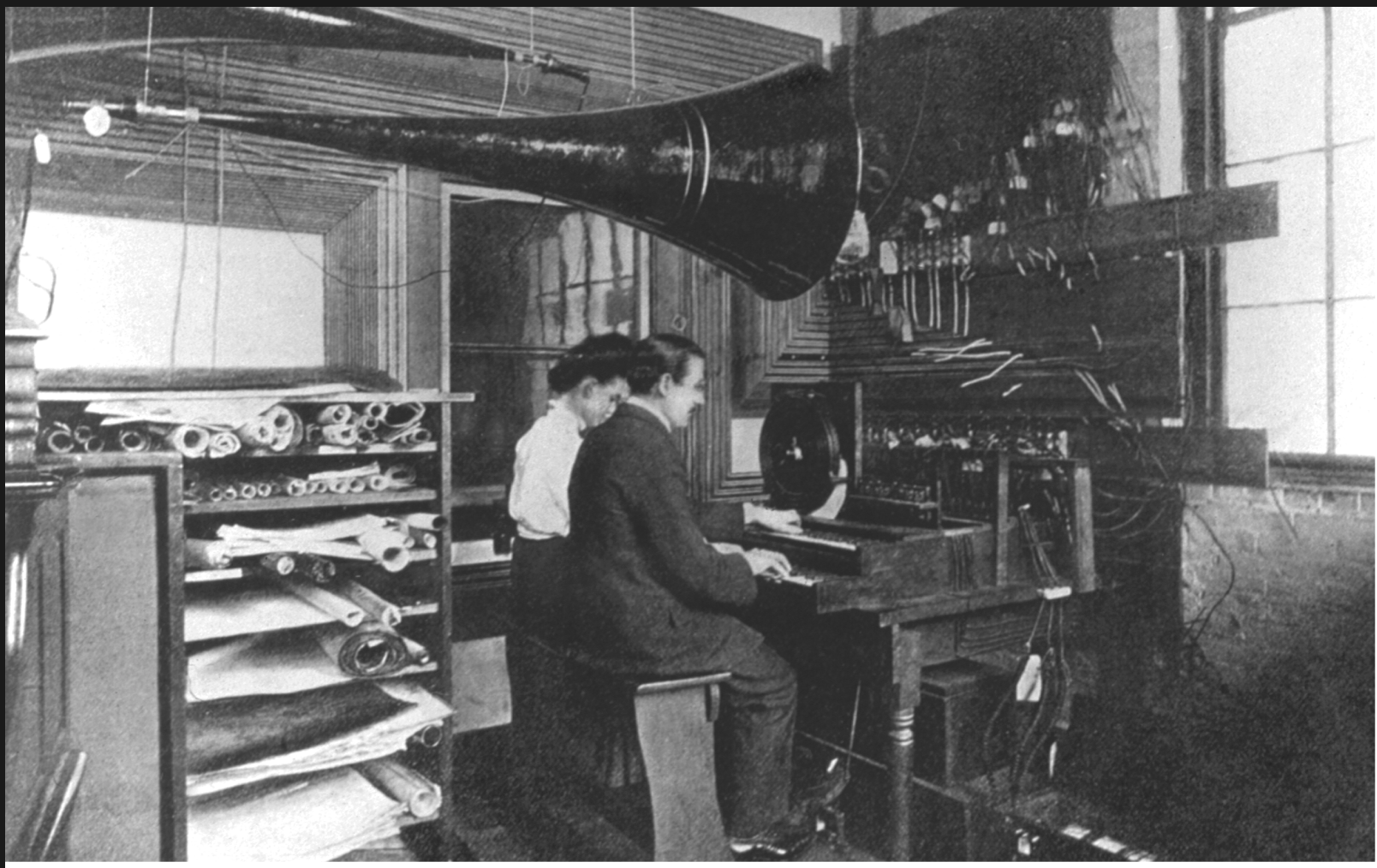

The earliest use of electricity to make music was in motor-driven acoustic instruments such as Delaborde’s Electric Harpsichord (1759). And some of the first discoveries in electrically produced sound happened accidentally, as when in 1837 Dr. C.G. Page inadvertently discovered the principle of the electronic tuning fork while experimenting with magnets and coils. In 1885, Ernst Lorenz patented an instrument in which an electromagnet alternately attracted and released small metallic bars.

Against the background of these and other early experiments, the electric music system designed and built by the American Thaddeus Cahill (1867-1934) is the tour de force of early electric musical instruments. Cahill’s designs were predicated on three 19th Century technological developments: 1) the harmonic theory, as demonstrated by Helmholtz some five years before Cahill’s birth, which theory indicated that a complex tone may be produced by summing individual sine waves (simple tones with no harmonics); 2) the development of electric generators (alternators or dynamos) which were known to produce alternating current in a sine-wave pattern; 3) the newly invented telephone, which acted as a transducer that converted sound into corresponding fluctuations of electricity that could be transmitted by wire and reconverted into sound by a telephone receiver.
Cahill reasoned that if the output of an alternator were connected directly into a telephone receiver a simple tone would be produced, The pitch of this tone would correspond to the frequency of the current produced by the alternator. Cahill also knew that alternator frequency could be controlled in several ways, including regulating the speed at which the shaft of the alternator is turned. It was apparent that the outputs of many alternators could then be thrown onto the line using switches connected through mechanical linkages to a modified organ keyboard. With many such alternators and an elaborate switching system using several miles of wiring, one could create the complete harmonic series for each key on the keyboard and adapt the stops on the console for regulation of the volume of each harmonic. It would then be possible to combine all of the various alternator outputs used in a single line using transformers, thereby creating at the telephone receiver complex tones whose timbres were under complete control. The use of dynamos and the telephone receiver gave rise to the descriptive names “Dynamophone” and “Telharmonium.”

If all of this is starting to sound a little like a Hammond Organ, it should. Laurens Hammond extended and used most of Cahill’s ideas some 35 years later. So why didn’t we have the Cahill tone-wheel organ in 1900? Primarily because Cahill’s design preceded some important technological developments. Lee de Forest’s “audion” (triode tube), which was the basis of the vacuum tube amplifier, appeared the same year (1906) that Cahill completed an advanced model of his Telharmonium. Within ten years, Dr. H.D. Arnold and others at Bell Telephone perfected the amplifier to the point where it could be used on transcontinental telephone circuits.
Because Cahill didn’t have amplifier technology, the Telharmonium was a roadie’s nightmare. Judging from photos and patent descriptions it weighed in at several hundred tons, and required a dozen railroad cars to be moved. These gargantuan dimensions were dictated because the instrument was designed to produce from twelve to fifteen thousand watts for each rotating element, without benefit of amplification.
Of course, Cahill had no idea of mass-producing the Telharmonium. He envisioned a network of telephone wires that would distribute “Telharmony” to thousands of distant subscribers. The Telharmonium was our first Muzak system!
Cahill’s earliest models produced electrical signals not with alternators, but with simple rotating tone wheels or “rheotomes,” that had alternate sections of conducting and insulating material. These tone wheels served to regularly interrupt an electrical circuit, creating alternating current. The complex waveform produced was smoothed to approximate a sine wave by filtering through successive inductances, Individual rheotomes were grouped with a fundamental frequency and up to seven harmonics, comprising a “rheotome cylinder.” Seven each of these rheotome cylinders were grouped on twelve long shafts, thereby producing the equal-tempered scale through seven octaves. A motor-driven system of pulleys which differed in diameter in the same ratios as the frequencies of the scale was used to rotate the twelve “pitch shafts.” C# rotated slightly faster than C, and so forth.

Of particular interest in Cahill’s early Telharmonium model was the keyboard mechanism. Through a complicated electromechanical action which eventually brought two coils into relative degrees of proximity, the loudness was varied dynamically. An electrical instrument with a touch-sensitive keyboard, designed before 1900! It is interesting to note that the interface between man and machine has been the subject of concern for instrument designers throughout the history of electric musical instruments. Designs come and go, but the value of giving the musician control over sound in the performance situation has been recognized from the beginning. In our next column, we’ll take a look at the public debut of the Telharmonium and examine some of its other expression devices.
FEBRUARY 1977
View or download the original article here: