

Thaddeus Cahill (1867-1934) was a rare designer who combined a talent for invention with the legal expertise to patent his ideas and the business acumen to interest investors in his turn-of-the-Century Telharmonium. This massive instrument, also known as the Dynamophone, was virtually an electric power generating plant, with dynamos rotating at the frequencies of the musical scale.

A prototype with 35 rotating rheotome cylinders (tone generators) was developed in Washington, D.C., during 1900 and electric music was “distributed” by telephone wire in the area. These demonstrations attracted investors who made it possible for Cahill to complete a more sophisticated model in Holyoke, Massachusetts. Among the technical improvements in the latter model was the introduction of a gear-driven alternator (dynamo) system for tone generation, providing more accurate intonation. The speaker system was also improved so as to avoid the “shouting” of some notes encountered with earlier speakers.

From the performer’s standpoint, an important feature of the new model was the multiple keyboard console, which could produce several tone colors simultaneously. The drawing below showing Cahill’s voluminous patents indicates details. Several pitch manuals (45) and a pedal (45) could be programmed for different tone colors using switches (55) to govern various harmonics. Swell pedals (95) afforded variable and independent loudness control over these manuals. In addition, a small “dynamic” manual (67) was provided to allow instantaneous loudness changes. Cahill stated that two performers were necessary to master the console.

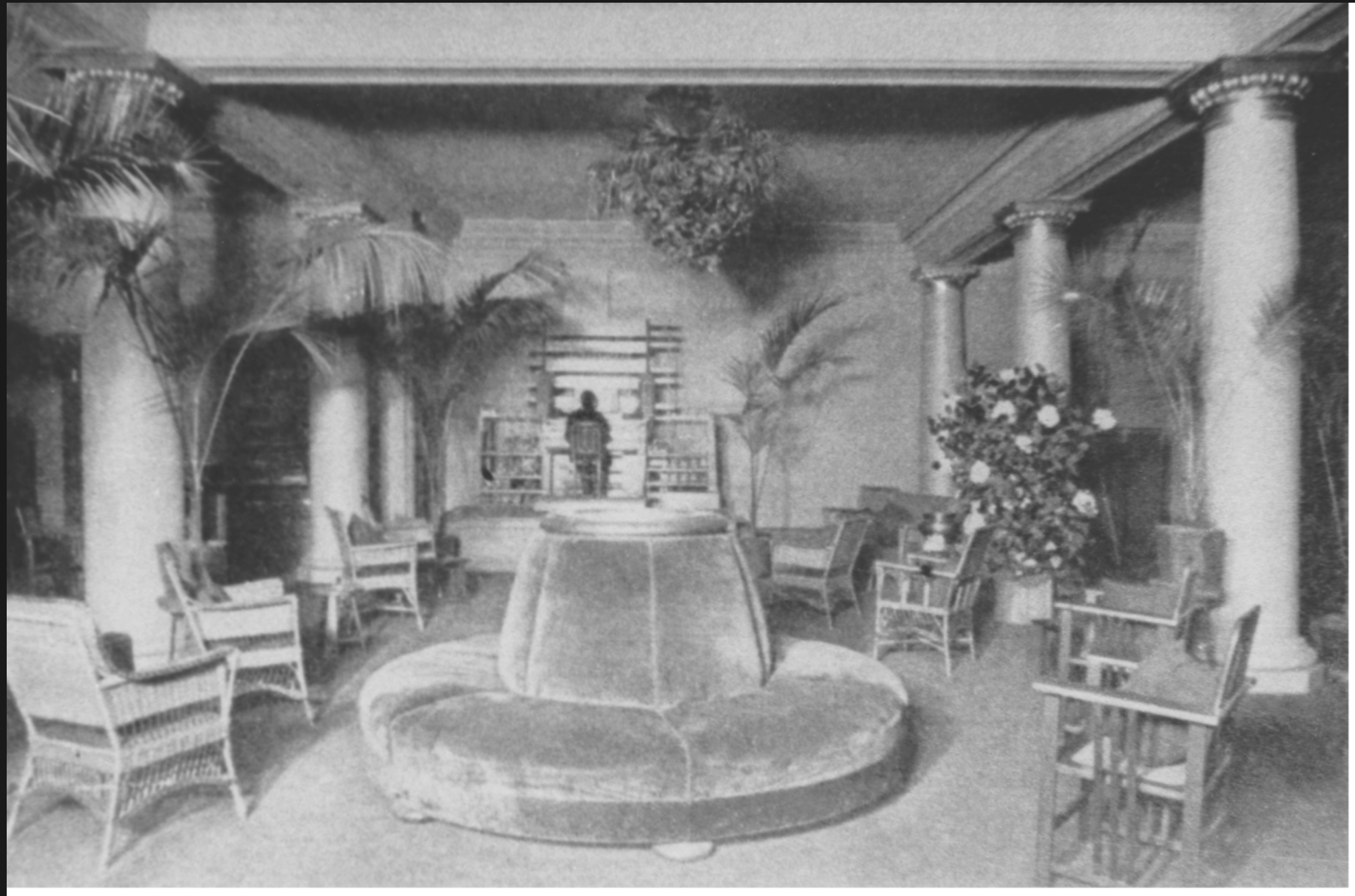
The summer of 1906 marked the commercial debut of the Telharmonium; demonstrations were made by wire at the Hamilton Hotel in Holyoke, about a mile from the plant. Media descriptions stressed the “fullness, roundness, and pureness” of the tones. Some reporters felt that Cahill had realized utopian predictions of music in the year 2000. Others hailed the Telharmonium as the harbinger of “democracy” in music, since fine music could now be delivered to “…towns, villages, and even farmhouses up to a hundred miles or more from the central station.”
Spurred by these rave reviews, Cahill packed up his instrument—on several railroad cars—and moved to Telharmonic Hall in New York City. In September the doors were opened to some 900 members of the New York Electrical Society for the first public Telharmonium concert. Officers explained that the plant had power to supply fifteen or twenty thousand subscribers, and that plans were underway to supply four circuits with different kinds of music. The concert included several “classical” transcriptions, imitations of instruments, sound effects such as the passing of a drum and fife corps, and several vocals with Telharmonium accompaniment. (Times haven’t changed much!) It was another round of success for Cahill’s heavyweight.
Although the outlook seemed bright and patronage was at first encouraging, the venture failed due to its own flaws before fledgling radio even had a chance to scuttle the music-by-wire concept. Evidently, Telharmonium wires wreaked havoc with normal telephone service due to the strength of the signal they carried. Cahill was beset with technical and legal difficulties, and many potential subscribers lost interest. Perhaps the Telharmonium would have failed in any case. As one of the performers noted, “In spite of the variety of tone color available, the instrument itself had its own special character which pervaded everything, and which in time grew highly irritating to the nerves.”
Even though the Telharmonium was not a commercial success, Cahill should be recognized as the pioneer in early electric music. The general principles he developed were successful later in rotating-wheel electronic musical instruments such as the Rangertone and the Hammond Organ.

MARCH 1977
View or download the original article here: