
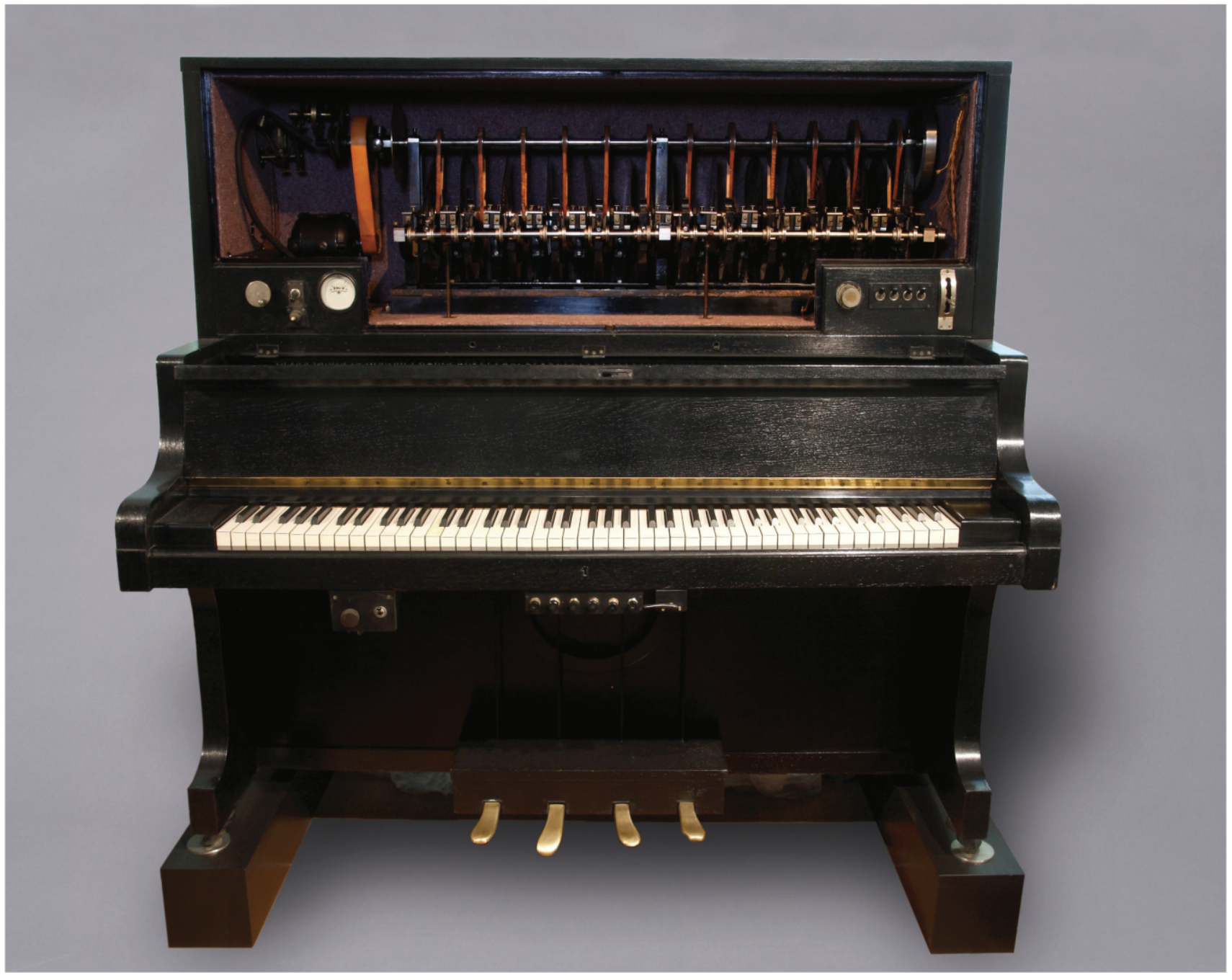

As explained in last month’s column, a “light chopper,” or rotating tone wheel, can be used to interrupt the light shining onto a photoelectric cell, generating alternating current that creates pitched sound. The Austrian Emerich Spielmann used the rudiments of this concept in his Superpiano, a photoelectric instrument developed during the early 1930s. But before we discuss this instrument, let’s take a look at a principle concerning tone-wheel generators in general.
Ideally, any rotating tone generator should conform to a basic requirement: for each wheel, the number of indentations, teeth, holes, photographed waveshapes, or whatever is responsible for creating periodic electrical currents, should be a whole number, and the spacing between repetitions on the wheel should be exactly uniform. Otherwise, noise may be introduced or faulty intonation result. Unfortunately, frequencies of our commonly-used equal-tempered scale have irrational (not reducible to integers) ratios rather than whole-number relationships; only octaves of a given note have a whole number as their common denominator (a 2:1 ratio). Therefore, it is difficult to meet the integer relationship requirement of rotating disk technology and still build a single disk that will produce all the notes of the equal-tempered scale. Richard Dorf gives a concrete example of the problem in his book Electronic Musical Instruments:
…if the disc is rotated at 6.125 [rotations per second], the 16-hole outer band produces G-98 [Hz] and the 8-hole inner band yields the G an octave lower at 49 [Hz]. You will find that there is no other [integral] number of holes which could be used at this speed to produce any other musical note [in the equal-tempered scale]. In fact, you will have to have discs going at twelve different speeds to produce the twelve different tones.
In short, it would require fractions of holes to create the equal-tempered scale. But we know that this introduces noise and bad intonation. However, as Dorf suggests, we might put all the octaves of a note on a single disk without violating the whole-number requirement. Twelve such disks rotated at the proper speeds would produce the equal-tempered scale. For instance, a wheel with seven concentric bands of holes, the outer band numbering 512, the one next to it 256, and so forth, can be rotated at 6.125 rounds per second to produce high G (3136Hz), low G (49Hz), and all the intervening octaves. An unbroken span of six octaves of the equal-tempered scale could be produced with twelve such wheels. If you look back to my columns on the Telharmonium [see C.K., Feb. & Mar. ’77], you’ll notice that Cahill solved the tone-wheel “problem” in a similar fashion.


Spielmann’s Superpiano was based on the work of an early experimenter named Thiring. Little is known of Thiring’s instrument except that it used twelve disks with holes that stood in octave relationships. A detail of the Superpiano tone generator shows twelve such disks of blackened film with light holes, and a mechanism which rotated each disk at the appropriate speed.
Spielmann’s most unusual contribution was a keyboard which sensed the depth to which a key was depressed. As the diagram shows, when a key (Touche) was depressed, a flexible band of metal (Lame ressort) came into contact with a resistive element (Rheostat), gradually covering it. As the element was more fully covered, the strength of current and hence the volume of sound produced was increased. The Superpiano was therefore touch-sensitive—in a way that was musically useful only to the extent that the performer could master the difficulty of depressing the keys to various depths. Obviously, this keyboard would have presented some difficulties during rapid playing, but just imagine the sensitive attack for lyrical legato passages!

Spielmann understood the limitations of his design and foresaw expanded possibilities for the Superpiano:
If, instead of mathematically calculated rows of holes on the tone plates of the Superpiano, photographic reproductions of single instrumental tones were fixed—a method known and accomplished since the sound film—the Superpiano would reproduce tones of this color in the loudspeaker. For example, it is possible to make a photographic record of the most perfect tones of Kreisler or Caruso, and adapt them to the tone records of the Super-piano. The Superpiano will then not only sound with the tone colorings of Kreisler’s violin or Caruso’s voice, but will compel the former to play contrabass and the latter to sing bass.
Spielmann also speculated about microtonal and theoretical scales with implications for composition:
There are future possibilities for music which the Superpiano can and will realize owing to its inherent powers. One can produce unlimited or theoretically-determined tone scales on it. . . . Aside from the realization of the whole-tone scale, a mathematically exact quarter- or eighth-tone scale can easily be built. With reference to tone coloring, the Superpiano offers the possibility of entering upon untrodden ground. The Superpiano will need but a small time for the full realization of the vast possibilities dormant therein.
But as with so many electronic musical instruments throughout history, evidently no one really exploited the “unlimited” possibilities for tone scales. The Superpiano failed to attain its predicted success.
Perhaps our perennial fascination with the tone-coloring possibilities of electronic instruments has partially blinded us to the necessity for electronic instruments that afford increased control over the nuance of sound—performance control. I wonder what would happen if we declared a one-year moratorium on the “low-cutoff-frequency-high-resonance-on-the-filter” synthesizer syndrome. Oh, for that great day when the producer doesn’t say, “Make it more electronic!” Or perhaps we might even settle for not knowing exactly which knob to turn when he makes that statement!

Upcoming columns will include more photoelectrics. Many designs have occurred, including some acceptable single-disk solutions to the tone-wheel integer requirement.
AUGUST 1977
View or download the original article here: