

The “light chopper” tone wheel of the type found in the photoelectric instruments described in my last two columns acts to interrupt the path between a light source and a photoelectric cell. The basic concept is that the amount of light that falls on a photoelectric cell can be manipulated over time in such a way as to produce tones of various pitches when the signal from the cell is sent through a speaker. In the case of a simple design, waveform selection is somewhat limited; only certain tone colors can be produced. But using more sophisticated design concepts makes it possible to use the photoelectric principle to produce a wider variety of tone colors, including recordings of acoustic instruments.
Several photoelectric instruments have been built that allow the production of an explicitly defined waveform or the reproduction of recorded sounds. Before looking at these instruments, however, let’s take a closer look at the photoelectric idea so we can better understand the design principles involved.
The output of a photoelectric cell is proportional to the amount of light falling on it—more light, more signal. Looked at another way, the more area of the cell we expose to light, the stronger the signal will be. That is, we can create a tone by controlling the amount of area exposed on the cell over time. Thinking in these terms, we can describe the light-chopper tone wheel in another way. When the opaque section of a typical light chopper is in front of the photoelectric cell, we can think of it as completely masking the cell. When the light slit on the wheel is directly over the cell, the entire area of the cell is exposed to light. Obviously, there are transition states, since the wheel moves smoothly from the masking position to the slit position, but it is apparent that this on/off system can produce only a limited array of waveforms. But if we had a way of masking the area of the cell that was exposed to light in a way that varied according to a specified pattern over time, we could produce any waveform that we could define, giving rise to a panoply of exotic tone colors.
There are two major ways of accomplishing this kind of photoelectric scanning, and they could be compared to bringing the mountain to Mohammed and vice-versa. The first employs an illuminated stationary scanning slit the light from which is modulated by a moving variable-area mask across it. Sound complicated? Just think of the soundtrack at the edge of a strip of movie film. The optical soundtrack is most often a variably darkened track that alters the amount of light allowed to fall on a photoelectric cell. Or, if you will, the amount of cell area that is exposed to light is constantly changing.
But for the time being, let’s concentrate on the second type, which is the converse of the first. In this case, the tone-defining mask remains stationary while scanning slits one fundamental wavelength apart are moved over it. (Let’s see, that’s equivalent to having one frame of film and moving hundreds of projectors over it every second!) Actually, this scheme should sound somewhat familiar. Suppose we place a piece of opaque material such as cardboard over the photoelectric cell, first cutting out the exact waveform we want to create. Now let’s take one of those rotating tone wheels with radially cut light slits—very narrow slits in this case—and place it between a light source and the masked cell.
As the slit passes over the hole in the mask, the mask will govern the length of the band of light falling on the cell, so that the cell will see a varying amount of light. We can control the amount of cell area that is exposed to light at any given instant by varying the shape of the mask. It should be apparent that this kind of tone generator will produce only recurrent signals—identical pulses will be produced as successive slits pass over the mask. Speech and other sophisticated, dramatically varying sounds wouldn’t be possible, unless you could become an incredible quick-change artist with the masks! The stationary mask design, though, does yield explicit control over waveform, thus making available a wide variety of tone colors.
Instruments of the stationary mask type were produced as early as 1921, when the Frenchman E. Hugoniot patented an experimental layout with photoelectric cells fitted with shutters cut according to a definite waveform. In 1929, the German A. Schmalz improved on this arrangement with the addition of accurately etched waveforms that he called phonograms. At the same time, Earle Kent in the U.S. was suggesting a photoelectric instrument of a similar type.
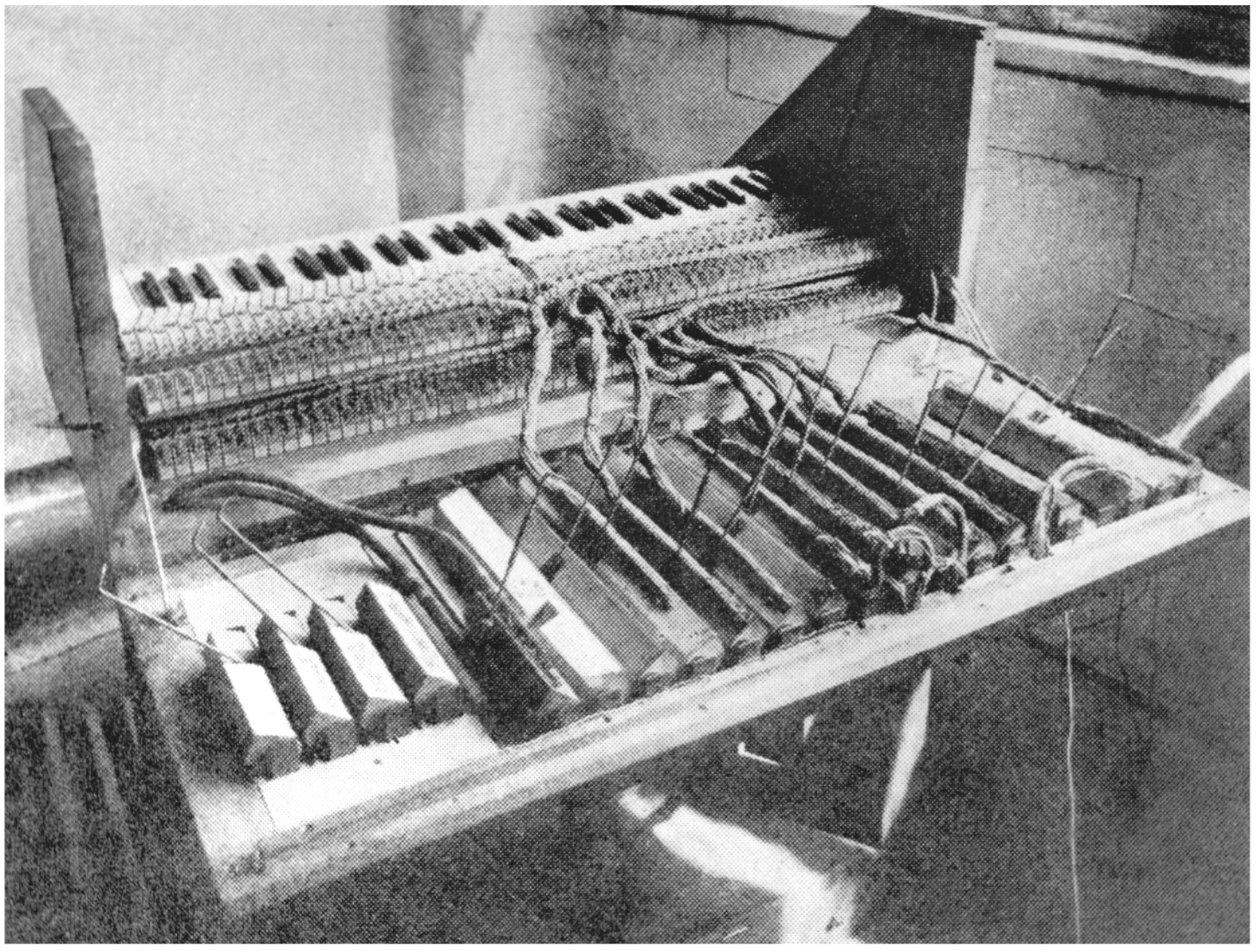
Only a small percentage of the designs for photoelectric instruments have led to complete instruments becoming commercially available. One that did was the Cellulophone, which was constructed by P. Toulon in France in the 1930s. The Cellulophone had the archetypal stationary mask design just described, but with some interesting features. Toulon used an optical arrangement that concentrated the modulated light beams from all the notes in a given octave into the same photocell. The keying of the beams of light associated with individual notes on the keyboard was achieved using small electromagnetically actuated shutters placed at the focal points of the respective beams. Four Tungsten filament lamps were placed in a row, with a pair of disks placed symmetrically on either side of each lamp, giving the instrument an eight-octave range.

The Cellulophone used a single disk to create the twelve semitones in each octave, an arrangement that does not conform to the requirements of good tone-wheel technology (see my column for Aug. ’77). The number of slits in each concentric row on a disk was undoubtedly a whole number (necessary to avoid sudden clicks or noise at the point of disjuncture in the row), and therefore the tone wheels had to have created tuning inaccuracies greater than the normally acceptable 0.1%. The Cellulophone was permanently out of tune.

Even considering the tuning problems, this instrument offered some interesting musical possibilities. Because each octave of keys was routed to a separate disk, it would have been possible to place a different waveform mask in each octave, creating a total of eight different timbres simultaneously on one manual. But although Toulon had the backing of several business firms, the Cellulophone never achieved any lasting popularity.

Next month, we’ll talk about some photoelectric instruments that made film music—literally!
SEPTEMBER 1977
View or download the original article here: