

In this final column in our series on photoelectric instruments, we’ll look at several keyboard instruments of yesteryear that could reproduce recorded acoustic-instrument sounds. (Yes, Virginia, the Mellotron and Orchestron have ancestors!)
As explained in my September ’77 column, these instruments used the same principle as the film soundtrack. That is, a varying “mask” is moved past an illuminated slit and translated by a photoelectric cell, becoming electricity and thence sound.
One of the earliest examples of this type of instrument was the Hardy-Goldthwaite Organ, built around 1930 by Arthur C. Hardy and Sherwood F. Brown using ideas provided by Du Val R. Goldthwaite, a patron of the arts in New York City. The instrument was polyphonic, and had a pitch span of 71 notes. Tones sounded at the frequencies of the equal-tempered scale were recorded and transcribed photographically onto a single disk. Separate disks could be used for different tone qualities or instrument voices. In this design, the concentric tone rings on the disk were not in an integer relationship, so the inventors had to overcome the abrupt click that many of the wave tracks created due to the sudden phase shift at the end/beginning of the track. (For a fuller explanation of this phenomenon, see my column for Aug. ’77.) Hardy devised an ingenious method for minimizing the discontinuities which occurred at the reentry point. Instead of allowing all of the phase shift to occur at a single point, it was divided among several points spaced equally around the wave track. In this way only a fraction of the total phase shift occurred at any given time, and the annoying click was avoided. (Incidentally, later versions of the tone disks for the present-day Orchestron use the same principle with computer-assisted transcription onto film.) The keyboard of the Hardy-Goldthwaite keyed shutters used to articulate the beams of light involved in the production of sound. According to B. F. Miessner, an authority on such instruments, the Hardy-Goldthwaite Organ used wave tracks “…translated from recorded waves of original [acoustic] instrumental sound.” It was possible to “play” string and voice choirs from the keyboard as early as 1930!
In 1936, another photoelectric organ using similar designs was introduced by Edwin Welte in Germany. The Welte Organ was produced commercially before World War II; it had glass disks etched with photographically transcribed tone patterns. Like the Hardy-Goldthwaite Organ, the scanning slits of the Welte remained stationary and the glass disks were rotated. Also similarly, the glass disks could be removed and changed at will, making various registrations possible. But the Welte had twelve rotating disks, and conformed to requirements for good tone wheel technology—it could produce an accurate equal-tempered scale. Not only did each tone wheel provide the same pitch in successive octaves—typical of this type of design—but it provided a selection of waveforms within each octave as well. This meant that the keyboard of the Welte could be scaled to produce different tone colors in each octave—subtle or radical differences.
In fact, Edwin Welte had hoped to bring the tones of world-famous pipe organs to music lovers everywhere by recording sound tracks from actual stops of famous European organs. (Not a bad idea; I’d buy one today if someone could provide it!) But the instrument was destroyed during the war, and the project was abandoned.

One of the most curious instruments from this era was the Singing Keyboard built by Frederick M. Sammis in 1936. His comments are typical of the euphoria of the time regarding the photoelectric principle:
Since it is possible to record any sound by the method used in talking pictures, suppose we consider just what a ‘singing keyboard’ can accomplish…. The talking and singing keyboard, together with electronic music, will place instrumental keyboard music on an entirely new plane, with new voice qualities and choral effects.
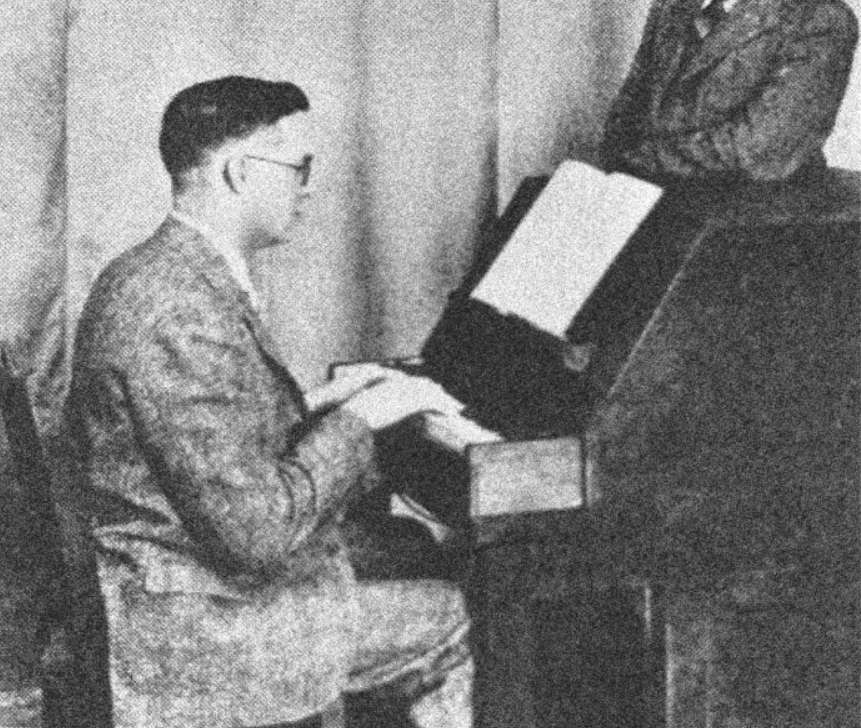
Sammis had come to Hollywood in 1929 to head up the “talking picture business” for RCA. He was familiar with the Moviola, or editing sound head. He reasoned that individual words could be uttered if appropriate strips of film soundtrack were pulled over the Moviola head. If this action could be placed under keyboard control—voila! (or Movoila!?)—the Singing Keyboard. But he encountered some problems:
How were we to release these words when any key was touched, how were we to start the word from the beginning only? How were we to prevent the words from repeating themselves? No form of rotating or continuously-moving sound track seemed to fulfill these requirements. Reciprocating sound tracks were resorted to and immediately produced the desired results. There was still a fly in the ointment, though. True, the depression of any key caused a sound track recording of the word to be drawn over a light slit and between the usual exciter lamp and light-sensitive photocell, and the word then would be spoken by the loudspeaker, but when the key was released, the film track would travel back over the same light path and not only mess up the word itself by saying it backward, but interfere with the music and other succeeding words as well!
Sammis solved these problems with a mechanism that caused a drum to be rotated ninety degrees when a key was struck. The attached sound track was drawn over the light slit and photoelectric cell as described. A shutter was used to obtain the required one-way action, so the word would not be heard backwards.

The detail at B shows the disc film holder and shutter employed.

Sammis had some very practical intentions for his Singing Keyboard:
Let us suppose that we are to use this machine as a special-purpose instrument for making ‘talkie’ cartoons. At once it will be evident that we have a machine with which the composer may try out various combinations of words and music and learn at once just how they will sound in the finished work. The instrument will probably have 10 or more sound tracks recorded side by side upon the strip of film, and featuring such words as ‘quack’ for a duck; ‘meow’ for a cat; ‘moo’ for a cow…. It could as well be the bark of a dog, the hum of a human voice at the proper pitch, or the universally understood ‘la la’ known to all, and to my mind, superior to much of the twaddle indulged in by some of our tin pan alley song writers.
If all of this sounds a little far out, just substitute magnetic tape for film soundtrack and playback head for photoelectric cell, and you would have an instrument something like a Mellotron!
Are these old instruments of any real interest today? Perhaps not in their original form, but just maybe…. Stop and consider that the most popular electric keyboards used by the working musician date back an average of at least 25 years in their design. Could we have missed something? Perhaps a further updating of music from light-fiber optics and laser technology will yield a futuristic instrument that realizes some of the musical dreams of the early designers.
The fascination of accurately reproducing and controlling acoustic sounds from a keyboard is as strong today as it was when photoelectric instruments first made it a reality. What do you think?
See you next month with a new topic.
NOVEMBER 1977
View or download the original article here: