

Where did the electric piano come from? Efforts to “electrify” the acoustic piano in the ’30s grew out of even earlier attempts to modify the instrument by non-electric means.
The mood for experimentation was brought about when sales of pianos slumped by fifty percent during the years 1913-1921. Some blamed the decline of the piano industry on the growing popularity of the phonograph and the radio:
It seems that the pianoforte is passing away. A few years ago the music shops were full of songs and piano and violin music; now they devote their space to gramophone disks and jazz records. Piano teachers complain that they have fewer pupils.
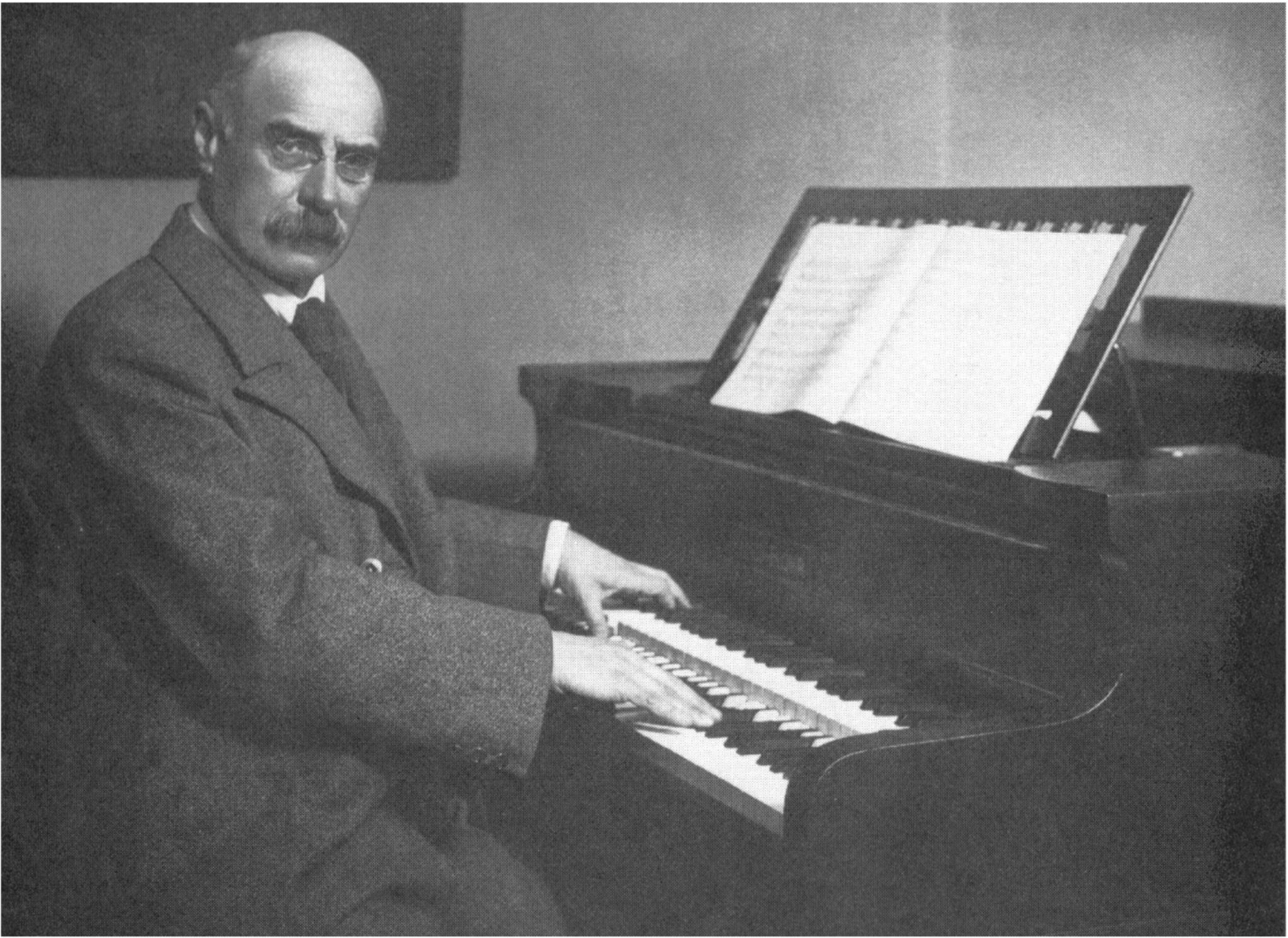
Several inventors offered modifications of the piano that were intended to create new expressive effects. In 1921, Emanuel Moór introduced his two-manual octave-coupled piano in England. With Moór’s piano it was possible to attain 4′ and 16′ tones (like an organ) similar to the tone of the single keyboard piano. The Moór piano generated some enthusiasm at first, but eventually faded into obscurity.

In 1925, a more successful piano was introduced in the U.S. by John Hays Hammond Jr. Hammond’s Breathing Piano used a series of pivoting slats mounted above and below the piano’s soundboard. The object was to control the release of acoustical energy from the soundboard. The following was a description of Hammond’s scheme:
Mr. Hammond conceived the idea of reflectors which should cover the entire top of a soundproof case. The reflectors are parallel revolving slats which can be opened and closed at the will of the player by the extra pedal in very much the way the old-fashioned slatted window shutter was manipulated. Since the case is soundproof, as are the metal-faced reflectors, the tone can be built up within the pianoforte and then permitted to escape at will. Furthermore, the reflectors can return to the sounding board a large degree of the energy imparted to the strings by the musician, the amount depending on the angle at which the reflectors are set by the pedal operator with respect to the sounding board. The return of energy to the soundboard was suggested to Mr. Hammond by the so-called regenerative action familiar to radio fans. The action achieved in the Hammond device is a sort of acoustic regeneration, maintaining vibrations of the soundboard for unusual durations of time.
There is some doubt that the idea of using shutters over piano strings originated with Hammond. But he did a great deal to popularize the concept. His Breathing Piano was presented in several demonstrations by Lester Donahue. Later, in 1929, Donahue made an extended concert tour outside the U.S., during which both concert pianist and inventor won praise. Even so, the instrument disappeared after a few years.

These experiments with the acoustic piano had little lasting effect. Several writers forecast a gloomy future unless something could be done to rejuvenate public interest in the instrument. Margaret Anderton wrote in The Musician:
The time has come, and has now ripened, for some further improvements in our well-beloved instrument. The whole scheme of the pianoforte is on the brink of great changes. Both manufacturers of this popular instrument and artists and players upon it have for some time been realizing the need for certain improvements.
Beryl Rubinstein, concert pianist, implied that the compositional possibilities for the piano might have been exhausted. He wrote:
I am not an inventor and cannot presume to say just what directions new ideas of piano playing or manufacturing will take. We seem to have traveled the full length of the road so far opened. We have scanned the scenery thoroughly. We must have a new horizon, otherwise we shall look no more, and not looking we will cease to think. There remains then stagnation.
The stage was set for the application of electricity to the piano—attempts to create an instrument with new tonal and expressive capabilities.
In 1930, Simon Cooper, a Brooklyn scientist and engineer, introduced his Crea-Tone, which was designed to prolong the tones of an acoustic piano. The Crea-Tone represents a halfway point in the evolution of the piano from the acoustic to the electric design. It used electrical circuits to maintain the vibration of acoustic piano strings. Conversely, today’s electro-mechanical pianos (Wurlitzer, Rhodes, and others) use vibrating elements to generate electrical oscillations. These pianos require a loudspeaker; the Crea-Tone did not.
The Crea-Tone was essentially a piano fitted with electrical feedback circuits designed to maintain any string in vibration as long as its key was depressed. Joseph Schillinger reported that the “…musical characteristic of the tone, which is produced by the help of electro-magnetic induction of the strings, is the absence of vibrato.” This instrument made it possible to achieve a continuous sound on some keys while others could be played as usual. A lyrical melody with staccato accompaniment was possible. A reviewer described a concert given at the Wanamaker Auditorium in New York City:
The effects of the sustained tones, with varied dynamic gradations and nuances being obtained by use of a pedal, was striking, especially in Chopin’s “Etude In E Major.” The increased prominence of overtones which the device apparently brought out, as well as the extra sympathetic vibration, resulted in many unusual effects. To the auditor the notes lost their characteristic pianistic quality and took on poetic and mixed timbre, suggestive of the same note being held simultaneously by an English horn, a saxophone, and an old-fashioned small reed organ.
Unfortunately, the Crea-Tone was short-lived. Today we see a reflection of Cooper’s basic idea in the E-Bow, a device that can be held close to guitar strings to give them infinite sustain.
Imagine an electric piano with pickups that transduce the movement of strings; the strings are kept in motion a la the Crea-Tone. But now we have an electrical signal that can be modified with synthesizer modules. Might this produce an instrument with the liveness of an electro-mechanical tone generator and the flexibility of articulation offered by voltage-controlled envelope and filter control? Maybe such a development could alleviate the idea that electronic musical instruments don’t sound “live.”
Personally, I am not ready to bring down the curtain on electro-mechanical tone generators; many of the instruments we play today have them. Perhaps some instruments from the past have potentially useful elements that are ignored because they are no longer “state-of-the-art.” State-of-the-art electronics doesn’t necessarily guarantee that an instrument will be musical.
DECEMBER 1977
View or download the original article here: