
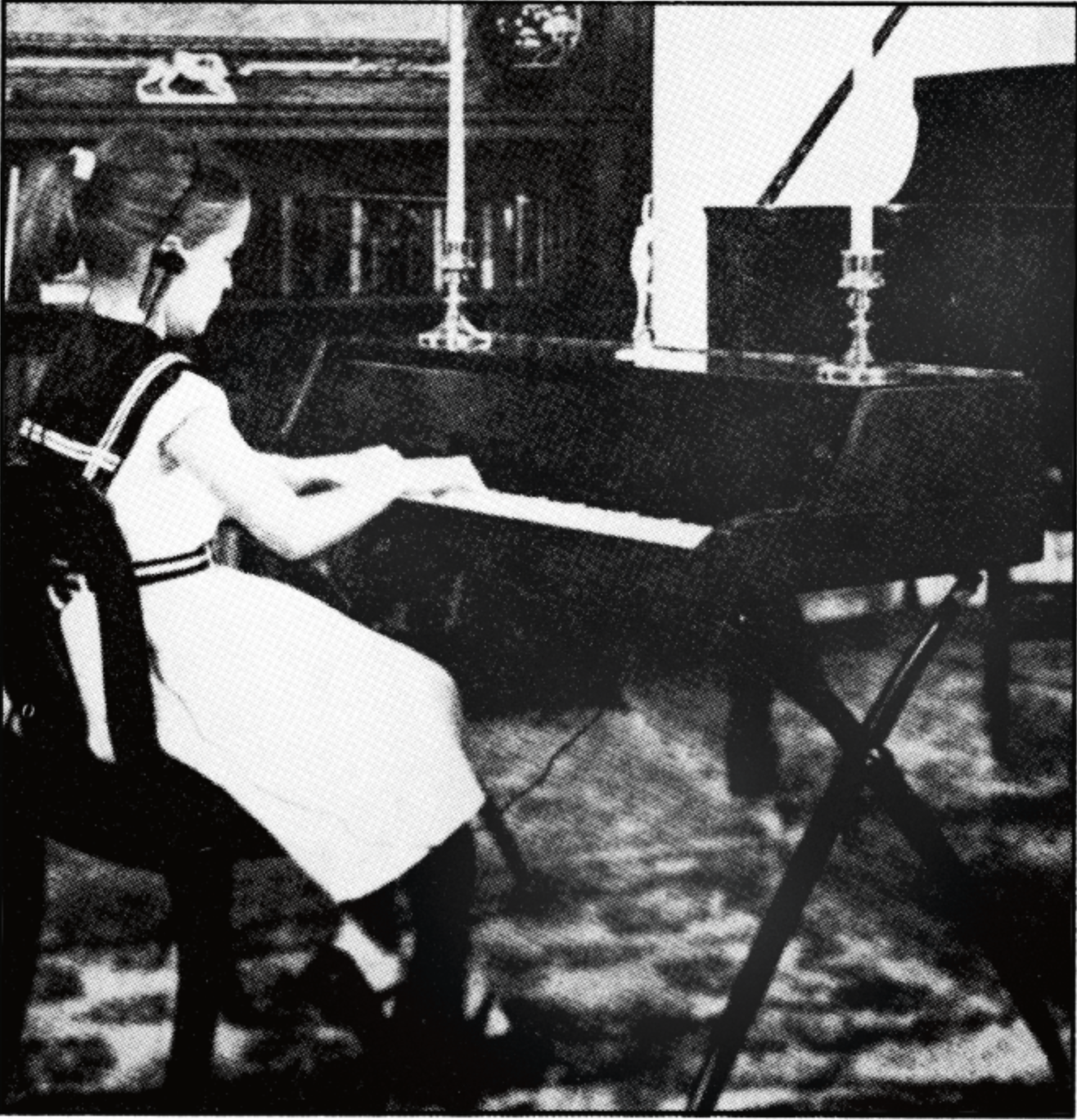

The electric pianos designed by Miessner, Vierling, and Nernst established archetypes for that industry during the late ’30s and early ’40s (see my columns for Feb. and Mar. ’78). These pianos were essentially acoustic pianos lacking soundboards, with electrostatic or electromagnetic pickups. They found some use, but these instruments had problems, as explained by Miessner:
Their performance, though interesting, was not suitable because the tones did not subside fast enough for clearness in rapid passages. The effect was such as is heard on conventional pianos when too much sustaining pedal is used.
This muddiness was due to the low damping rate of the strings—no soundboard was present to dissipate acoustic energy. There were also some commercial considerations: such a piano wasn’t more portable or cheaper than an ordinary piano, since its design required the use of an acoustic piano in the first place. Furthermore, the electric version offered no advantage in tuning stability.
To correct these problems Miessner developed an electric piano in 1955 that is the basis of the Wurlitzer Electric Piano. In that year he wrote: “I went back to reeds again in my recently developed electronic piano. They are simple and rugged and can hold their tuning for decades.”

Miessner’s new piano had thin steel reeds measuring one quarter of an inch wide. The reeds were struck by key-actuated hammers having a very simple action. This action used the principle of the “dash-pot,” or centrifugal force, instead of the friction-damping mechanism invented by Cristofori in 1709. Think of a dash-pot as a tiny canister full of buckshot attached to the striking key. After the key is struck, the centrifugal force of the accelerating pellets will cause the string to be struck, then the hammer to fall back.
The use of reeds for the electric piano offered some problems, as Miessner explained:
Reeds have been successful only when maintained in continuous vibration, as in reed organs, accordions, and orchestral reed instruments. They have never been found useful in true musical instruments of the percussion family [piano included in this category]. Their overtones are few and completely inharmonious with one another.
In a word, the reed didn’t have the proper waveform. Miessner solved this problem by striking each reed at its third partial nodal point, and arranging the pickup so that it negated the second partial as well. This left only the fundamental vibration to be translated by the pickup. He then designed the pickups so they themselves—in conjunction with electrical circuitry—would generate a fundamental and a series of odd and even harmonics.
The pickups were made of machined brass; they were placed near the free ends of reeds which were clamped at the other end. Each pickup was the same thickness as a reed (.032 inches); each pickup was adjusted to overlap the end of its reed by about one-half of its thickness. Since the pickup was set at this half-lap position, when the reed moved symmetrically the pickup would produce an asymmetrical waveshape having many harmonics—a “rich” sound. The pickups acted as stators of variable capacitors, while the vibrating reed acted as the moving plate. The changes in capacity due to reed vibration caused a very high (5 megahertz) oscillator to produce a frequency-modulated signal. This signal was then demodulated into sounds by an FM detector—a la the radio! This output was modified by audio filters and tone formers which approximated some of the characteristics of the standard piano soundboard; e.g., a sharp roll-off in the bass.

Miessner’s piano of 1955 satisfied many of the criteria that his brother Otto, a noted music teacher, had hoped for. Benjamin Miessner wrote of the instrument:
The electronic piano can be much smaller, lighter, and cheaper than its predecessors. The basic model, cabinet containing keys, action, reed pickup assembly, and FM preamplifier, weighs 75 pounds and can be handled easily by one man. This reduction in weight, bulk, and cost is due to the reed action, which makes it possible to abandon the long strings with their aggregate tension of about 20 tons which necessitates the heavy cast iron plate and bulky wood buttressing. The large area soundboard is also abandoned.

Miessner saw this instrument as only the initial step in the use of this technology:
This new stringless piano may be the forerunner of a whole new class of electronic musical instruments of widely differing tonal performance. The lowly fixed-free reed, virtually the “sow’s ear” among musical vibrators, had become the “silk purse” of electronic design and technique with the great advantages of low cost, weight, and bulk, silence when desired with headsets, and the ability to stay in tune for many decades.
Several years ago, I was fortunate to spend considerable time with Mr. Miessner while doing research in the history of electronic musical instruments. At that time he had in his garage a “much more advanced version” of an instrument using this technology. He had sought a manufacturer (not the Wurlitzer Company) but was refused; he was so distraught that he had not even uncrated the instrument. When I asked him if I could play it, he said it would be too painful to “dig it up.” Was his piano truly the forerunner of a whole new class of electronic musical instruments? Given his brilliant career, it certainly makes one wonder….
APRIL 1978
View or download the original article here: