
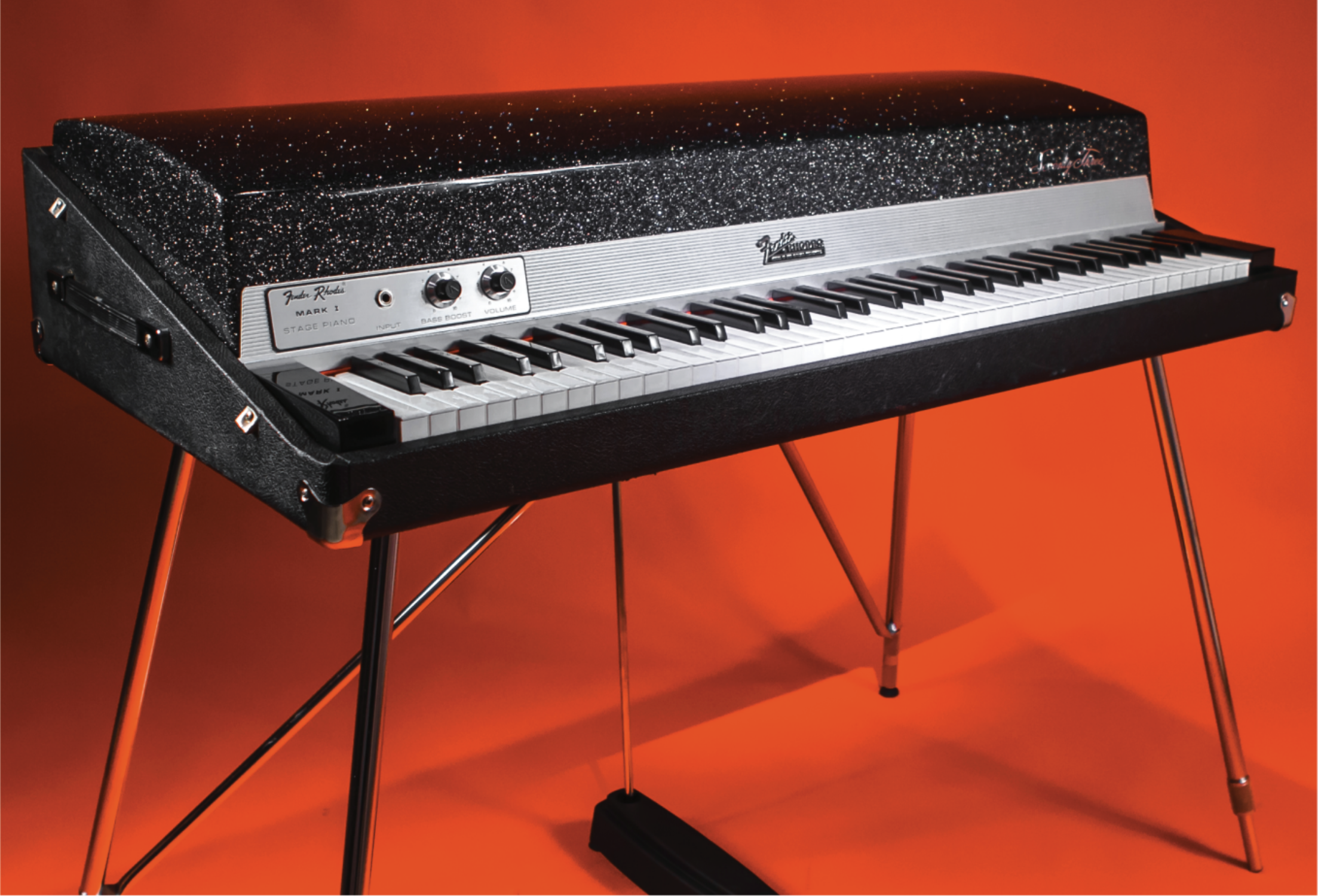

“Teaching is my forte—inventing is not.” These modest words come from Harold Rhodes, the inventor of the electric piano that bears his name.


That Harold Rhodes is both a teacher and an inventor is well documented. By age 20, he had established a nationwide chain of music schools that specialized in teaching popular piano. Most people are familiar with the present Rhodes Electric Piano—an instrument Rhodes describes as “…a plain Model T, simple.” But perhaps they are not so familiar with its history.

When World War II broke out, Rhodes dissolved his organization of music schools and joined the Army Air Corps. Ever the teacher, he began to teach his Army buddies piano while waiting for a reclassification. Eventually he was asked to teach patients in the post hospital. Rhodes the inventor immediately realized the necessity for a cheap but usable keyboard instrument. In the typical make-do wartime spirit, he fashioned a small instrument from spare parts salvaged from disabled planes. He scavenged the “tone bars” for the piano from the hydraulic system in the wings of the planes. The Air Corps Piano was an acoustic instrument; tones were produced by striking lengths of the 3/8″ aluminum hydraulic tubing that had been straightened and cut into xylophone lengths. The 2-1/2-octave keyboard had wooden keys (spruce) and bare wooden hammers that struck the tone bars. Rhodes himself describes the Air Corps Piano as “…such a simple instrument it was almost ridiculous.” But it fit his purpose well, as he states:
My objective at the time was not to produce some instrument that I could sell. It was to satisfy the need to get the minds of the convalescing soldiers off their problems. We did it by transforming their telephone numbers or whatever numbers they could grab into melodies, and then harmonizing them with simple chords.
The program became a smash hit. Rhodes was sent to Mitchell Field, Long Island, to draw up blueprints and write a book of instruction which became Army Manual #29, “Sit Down And Play.” Eventually, thousands of these little instruments were built and Harold Rhodes was decorated for his role in this humanitarian project.

When Rhodes got out of the Army, he began to wonder if his teaching success in the service could be duplicated in civilian life. He realized that the Air Corps Piano wasn’t suitable for home use, so he sought to produce an inexpensive instrument that could accomplish “…roughly in the home what those guys were doing on the Army post.” His new 3-octave instrument, the Pre-Piano, used tone generators made from tines produced by a toy manufacturer. These were about an 3/8″ in diameter, and the longest was about 8″ long. This instrument used an electrostatic pickup; it had an amplifier and a 6″ speaker built into the console. Despite its low price tag ($199.50) and innovative design, the Pre-Piano failed because, in Rhodes’s words:
The manufacturer we chose didn’t produce a mechanically sound product. In fact, I found myself going to each of the stores where we were introducing these…with a pocketful of tools trying to fix them all. After about two years, the program died a miserable death.
Harold Rhodes is still refining his electric piano today [for more on Rhodes, see CK, Nov. ’77]. Some may think of the Rhodes Piano as completed, but not Mr. Rhodes. When asked if there might be a Super Rhodes Piano, he remarks:
I think there will be. I’ll tell you what the Super Rhodes Piano does. Visualize an interface between the piano and [the synthesizer]. You’ve got a multiplex receiver on the one end, and I put a multiplex sender on my end. I can run as few as seven wires and a switching mechanism under my keys. If you’ve got a Polymoog I can connect the two so that when I am playing the piano, I’ve got the percussion of the piano and the sustain of the piano and I’ve got the Moog all at the same time. This is not saying that this is the end-all. It’s just a beginning, to show that there is a way of wedding these two.
I’ve got an acoustic characteristic to my music. That is, C is not exactly C and E is not exactly E the same way twice. And there is percussive control that is dynamic. I don’t know how far downstream it will be, but I think it can be better than it is. And I think some things can be done to shape the tones and preserve the acoustic quality it seems to have.
Rhodes has also considered the idea of passing each individual key through a filter to allow envelope control. As he says:
We’ve done this. The trouble is that when I was doing it, the cost was prohibitive. I’d have had to fill a room with RC [filter] networks. But the day is fast approaching when it can be done.
History will indeed find a place for Harold Rhodes as both teacher and inventor.
MAY 1978
View or download the original article here: