

To make sound, something must vibrate. When you speak, your vocal cords vibrate. When you talk through a PA, the sound of your voice is transduced from mechanical energy into an electrical signal. This signal is amplified and then transduced back into sound by the speaker. In this case the original signal (your voice) isn’t electronic, it is mechanical.
In previous columns we’ve looked at some instruments that have mechanical tone generators whose movement is transduced by a pickup, reader, or the like. These are electromechanical musical instruments.
In upcoming columns we’ll look at some electronic musical instruments, whose tone generators consist of electrical circuits rather than moving parts with transducers.
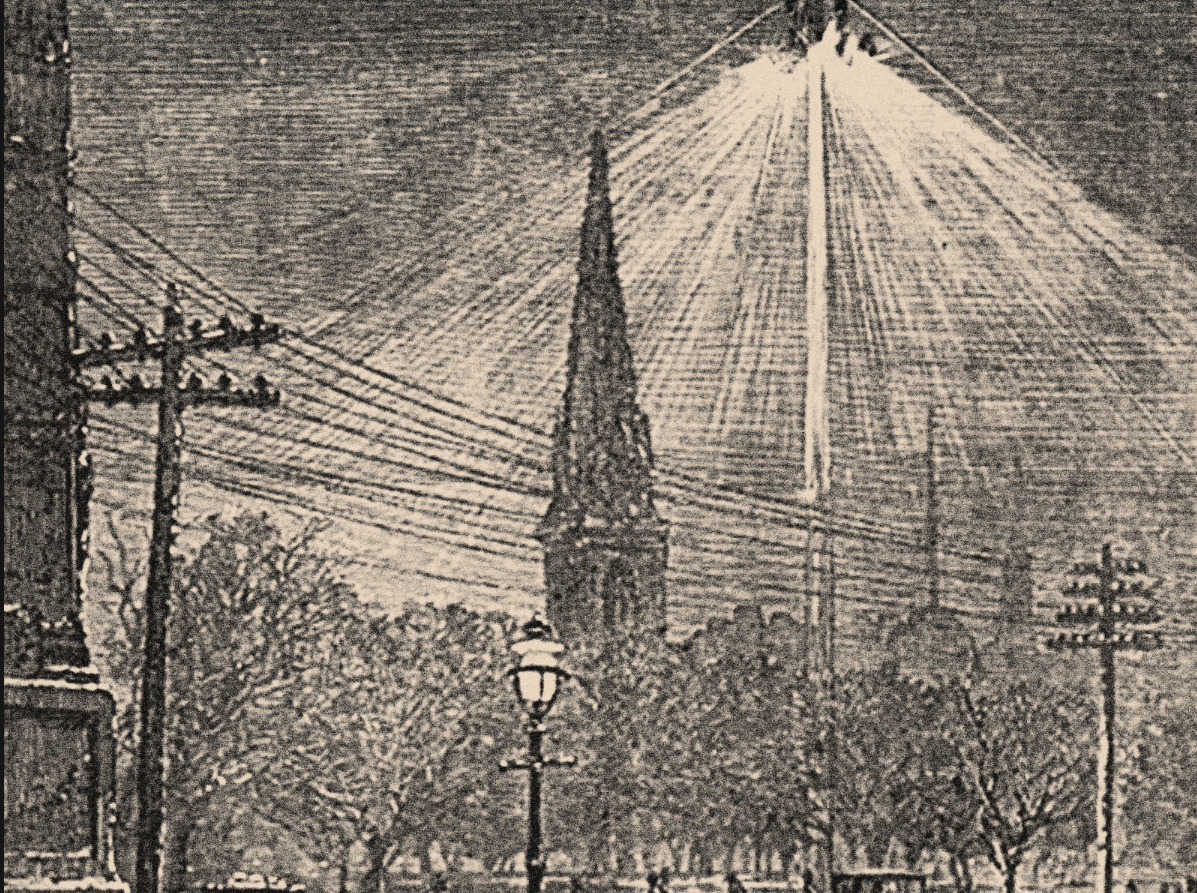
William Duddell, an English physicist, built the first “electronic” musical instrument in 1899. He discovered that the carbon arc lamp could be made to produce musical tones. (You’ve probably seen large carbon arc lamps at the State Fair, or at Hollywood premieres.) Duddell’s Singing Arc was a direct current arc with a secondary or shunt circuit that created regular fluctuations (alternating current) in the discharge, making a sound. In this case, the arc itself acted as the loudspeaker. High potentials (300 volts!) gave clear notes; their pitch and loudness depended upon the circuit values for capacitance (C), inductance (L), and resistance (R).
Duddell built a keyboard which controlled these circuit characteristics, creating what must have been the first electronic keyboard instrument, in 1899! When he played the Singing Arc before the London Institution of Electrical Engineers, arc lamps in several nearby laboratories also played tunes during the demonstration. The mystery was cleared up when it was discovered that these lamps were on the same circuit with Duddell’s musical arc. When the Singing Arc was played, it produced variations in the main line, thus accounting for the strange behavior of the other arc lamps. The possibility that several arcs could be played remotely from a single keyboard led to speculation that concerts might be given in conjunction with lighting service. Early Muzak, featuring light classics? But Duddell didn’t pursue the matter and abandoned his application for a patent.
Since lugging huge arc lamps around has never been the touring musician’s dream, we awaited the development of the more practical “radio valve,” or vacuum tube. The vacuum tube provided the foundation for amplification, and made electronic tone generators possible.
Thomas A. Edison started the ball rolling in 1883—quite by accident while experimenting with the incandescent light bulb. He was trying to prevent the bulb from becoming blackened by carbon deposits given off by the filament. He built several bulbs with a metal plate opposite the filament inside the evacuated bulb. This plate was connected to a wire sealed into the glass wall of the bulb so the plate could be electrically charged. Edison soon discovered that a positive charge allowed current to flow onto the plate (negatively-charged electrons emitted by the red-hot filament were attracted by the positively-charged plate.) Conversely, a negative charge on the plate stopped current flow. This phenomenon became known as the Edison effect.
In 1884 Edison described the Edison effect and exhibited his filament/plate bulbs. Ambrose Fleming, a British physicist, saw the demonstration and eventually, in 1904, made a useful application of the Edison effect. Fleming’s device, which we would now call a diode tube, was used as a detector of radio waves. Here’s how it worked: The feeble radio waves received by an aerial were applied to the plate inside the Fleming bulb. When the electrons rushed one way in the aerial, they created a negative charge on the plate and no current flowed. When the electrons flowed the other way in the aerial, a positive charge was produced on the plate and current did flow. The continual variation in the strength of the radio waves formed the message pattern (voices, music, etc.) which was “detected” by the tube as a corresponding variation of current flowing through the tube. This output, when applied to a telephone receiver (speaker) created sounds similar to those which originally struck the microphone at the broadcasting studio.
Fleming’s development greatly facilitated research in radio throughout the world. In the United States in 1906, Lee de Forest introduced an improved tube which he called the Audion. Its importance cannot be overestimated. The Audion was more sensitive than the Fleming tube and could be used to amplify weak radio signals into currents of enormous strengths. (Those who have sustained hearing losses at rock concerts can blame/thank de Forest.) The Audion was a three-element (triode) tube, consisting of the standard filament and plate with a grid of metal placed between the filament and the plate. This grid acted like a sluice-gate to control current flow. Because the grid was placed close to the filament, a small potential placed on the grid had a much larger effect on the field within the tube, and therefore on the plate current, than would the same voltage placed on the plate itself. De Forest applied radio waves not to the plate, but to his new grid, thereby controlling a much greater current flowing from filament to plate. Fluctuations applied to the grid resulted in much bigger fluctuations at the plate. This principle of amplification underlies the development of electronic musical instruments.
So far, so good. We’ve seen that it was possible, in the early days of radio, to transduce mechanical energy using a microphone, transmit and detect the resulting radio waves, and amplify them and turn them into sound again. But this is only an example of transducing a mechanical tone generator such as the radio announcer’s voice. We still don’t have an electronic tone generator.
For the beginnings of that story, let’s take another look at Duddell’s Singing Arc. The secondary or shunt circuit has a capacitor and an inductance coil. This kind of circuit was to become commonplace in later electronic musical instruments, and is now called a tank circuit, or L-C circuit, after its use of components. But aside from such bizarre configurations as in Duddell’s 300-volt tone generator, the tank circuit is capable of producing only damped oscillations, or a signal which dies out. By itself, the tank circuit would be of little use as an oscillator, since continuous sound could not be maintained. But it was discovered that undamped, continuous oscillations could be produced if a small amount of current was fed back into the tank circuit at the right time using an amplifier. And so, the basis of the L-C oscillator was also de Forest’s triode tube. More on de Forest’s Audion and some early L-C oscillator instruments next time.
JUNE 1978
View or download the original article here: